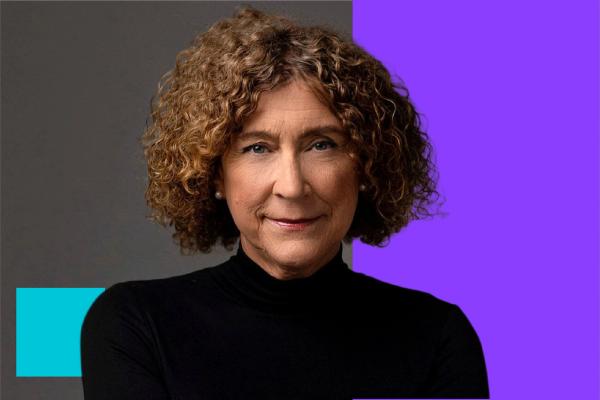
Dying Before Dying: The Grief of Life Transitions
There was no ceremony to say goodbye to the man Paula Stone Williams was before she transitioned to being a woman. Despite being a pastor by training, Paula was unprepared for the despair this death before death triggered for her and those she loved. Combining tremendous honesty and expansive spirituality, Paula offers comfort at a time when many of us are mourning the loss of who we once were while searching for a way forward.
Take 10 is an experience focused on finding solace, building solidarity and sharing solutions when it comes to serious illness, caregiving and end of life. If there’s one thing we hope you take away from this experience, it's the invitation to create the narrative of your life through to its end. May you find comfort and joy in the process of digging into what it means to embrace the good, the bad, and the messy about the gift of being alive!

January 15, 2021
Transcript
I was the CEO of a large religious nonprofit, the host of a national television show and the editor-at-large of a national magazine. I was a successful, well-educated white American male.
But the poet and mystic Thomas Merton said, “It’s a difficult thing to climb to the top of the ladder of success, only to realize when you get there that your ladder has been leaning against the wrong wall.”
I knew from the time I was three or four years of age that I was transgender. In my naivety, I thought I got to choose. I thought a gender fairy would arrive and say, “Okay, what’s it going to be?”
But alas, no gender fairy arrived. So I just lived my life. I didn’t hate being a boy. I just knew I wasn’t one.
I went to college, got married, had kids and built a career. But the call toward authenticity has all the subtlety of a smoke alarm, and eventually decisions have to be made.
And so I came out as transgender and promptly lost every single one of my jobs.
I had never had a bad review, and I lost every single job.
In all 50 states in the United States, you cannot be fired for being transgender. But in all 50, you can be fired if you’re transgender and work for a religious corporation.
Good to know.
It’s not easy being a transgender woman.
I was part of a large evangelical denomination of about 7,000 churches. I was a pastor and one of our national leaders. I knew thousands and thousands of people by name.
But when I came out, those people disappeared overnight. They treated me as if I were dead and gone. Of the thousands of people I knew, I’ve seen exactly 20 since I transitioned, six more than once.
It’s hard to have one life completely end and to have to build a new life from scratch. I mean, what do you do when there’s this dying before dying?
On top of that, my family has had a difficult time knowing what to do with Paul. I’ve had a hard time knowing what to do with Paul.
There are no pictures of Paul on my walls. We don’t talk about Paul very much. We all admit it would have been good if we had held a memorial service to memorialize my previous life, but all of us feel like it’s too late to do that now.
Not long ago, I was down in my basement doing some cleaning, and I found several copies of a book I wrote 20 years ago. I thought, “Let’s save the copies to give to my granddaughters.”
There are 43 stories in the book. I stood there and read one of the stories about the day I took my youngest daughter off to college, and how we stood in the stairwell at her dormitory and she cried and said, “Dad, I can’t do this.”
I said, “Yes, you can. You can do this.”
But then I drove home and thought to myself the whole way, “I can’t do this. All three children are gone. What do I do, seeing their empty beds every night?”
We go through so many passages.
After reading that first story, I just sat down on the cold concrete floor, leaned against a cardboard box full of Thanksgiving decorations and read another story from the book, and another, and another, until I had read all 43 stories.
I cried and cried and cried.
I liked the guy who wrote the book. He seemed thoughtful, caring, gentle, kind.
Oh, he was clueless. Clueless about his entitlements. Clueless about his privilege. Oh, I wish I could go back and talk to him about those things.
But I realized he lived an honest life. He did his best.
That night was the closure I needed.
You know, the hero’s journey is common to every culture, every age, every language, every ethnic group. It always has the same elements.
An ordinary citizen is called onto an extraordinary journey, onto the road of trials. Initially, they reject the call because, hey, it is the road of trials.
But now they’re miserable because they know they’ve been called. And in their misery, a spiritual guide comes to them, a Yoda, if you will, and gives them the courage to answer the call.
And they answer the call, and sure enough, it’s the road of trials.
And then it gets worse.
They find themselves in a deep, dark cave, what Dante was talking about at the beginning of The Divine Comedy when he said, “In the middle of the road of my life, I awoke in a dark wood where the true way was wholly lost.”
In that dark cave, you are completely lost. But then you realize another important lesson.
Lost, well, lost is a place too.
And it’s all right to have to spend some time in a place called lost. There are things you can learn there that you cannot learn any other way.
And if you finally tough it out, you see the light at the end of the tunnel. And this time, it’s not an oncoming train.
You’re back on the ordinary road of trials, which now feels like nothing compared to what you’ve been through. And then you get to the prize of great price, the Holy Grail.
But still, your journey is only half over, because now you must take what has been given to you and return, giving it as an offering to those from whom you departed.
Only then are you free to move on.
You know, all of us are called onto the hero’s journey. The question isn’t whether you’re called or not. The question is whether or not you answer the call.
And it doesn’t matter how long it takes you to answer that call. It took me six decades.
But you answer the call because you know you have no choice in the matter.
Early in life, we’re busy building résumé virtues, slaying dragons, amassing fortunes, building kingdoms. But the day comes when that’s just not working for you anymore.
And we start working on eulogy virtues.
We finally have fewer friends, but deeper friendships. We no longer look outside ourselves for our sense of self-worth, but instead look deep inside our own souls.
We no longer look to others to find our sense of purpose, but instead find it, again, deep within our own souls.
We’re no longer nearly as concerned about being right as we are about being in relationship. And we recognize that when a call comes, we have no choice but to answer it.
That’s because the call toward authenticity is sacred and holy and for the greater good.
And how do you know when that call has finally come?
I think David Whyte puts it well:
“When your eyes are tired, the world is tired also.
When your vision has gone, no part of the world can find you.
Time to go into the dark where the night has eyes to recognize its own.
There you can be sure you are not beyond love.
The dark will be your home tonight.
The night will give you a horizon further than you can see.
You must learn one thing.
The world was made to be free in.
You must give up all the other worlds except the one to which you belong.
Sometimes it takes darkness and the sweet confinement of your aloneness to learn
that anything or anyone that does not bring you alive
is too small for you.”
The call toward authenticity is sacred. It is holy. It is for the greater good. And it is universal.
And to answer that call, it’s worth it.
Thank you.
RELATED