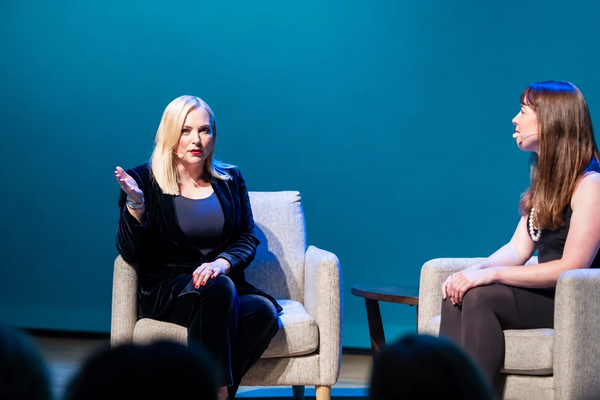
Undying Love
Lucy Kalanithi has said that one of the most important aspects of caregiving for her husband was helping him maintain his identity as his capacities narrowed. Frank Ostaseski calls the foundation for this support of the whole individual “undying love.” Together they share the experience of fully embracing the suffering, beauty and wonder of staying connected to the essential person at the center of care.


December 7, 2017
Transcript
Lucy Kalanithi: This is so nice. I’m really glad to be here. This is such a special gathering.
Frank and I did a planning call, kind of a conversation to get ready, and I felt like I was in therapy. So I feel like we all get to do 25 minutes of therapy with Frank. It’s not a 50-minute hour. We have half an hour.
Anyway, I’m so glad to be here with you. I think we were thinking we would start by talking a little bit about who we are and what we’ve learned through what we do.
Do you want to go first?
Frank Ostaseski: Yeah, I could.
First of all, it’s lovely to be here with you. What an exciting, dynamic conference.
In Japanese Zen, there’s a beautiful term called shōji. Lucy and I were just talking about it. It translates as “birth-death” or “life-death.” It’s one word, really, a hyphenated word: life-death. There’s no separation between life and death, just a thin line connecting the two of them.
In my work, at least, I think we really can’t be fully alive without including death. Death isn’t waiting for us at the end of a long road. She’s right here in the marrow of every passing moment. She’s the secret teacher hiding in plain sight, showing us what matters most.
The really great thing is that we don’t have to wait until the end of our lives to find out what she has to offer us. In fact, to imagine that at the end of our lives we will have the physical strength, the emotional stability and the mental clarity to do the work of a lifetime is a ridiculous gamble.
I’m glad we’re having this conversation now.
One of the things we talked about is that we just wanted to visit with you and each other and be real in the conversation.
I’ve worked with a couple thousand people who died. Death was sometimes beautiful, messy, painful and often transformative. But most of all, it was normal. It was ordinary. We all go through it. None of us gets out of here alive. I mean, maybe today you will, but I don’t think so.
That’s just a way to get us started. How about you?
Lucy: I was reflecting on the way over here, thinking about what lessons I bring or what I would say.
One of the things I learned through our family’s experience, for people who don’t know about it, is that my husband, Paul, was diagnosed with stage IV lung cancer as a senior neurosurgery resident at Stanford. He initially went back to work as a physician and then turned toward writing during the last year of his life. He wrote the manuscript for When Breath Becomes Air during that time.
When he died, the manuscript was a Word document on his computer. It was published about 10 months after he died.
I remember asking his agent, “This book is coming out, and Paul isn’t here to promote it. How do you think it’s going to do? What do you think is going to happen?”
I was sort of steeling myself for what might happen.
She said, “It’s either going to do terribly or fantastically.”
I was like, “Thanks. I understand the limits of how it could do.”
She said, “It really depends on whether people want to read a book about dying by a person who recently died.”
It has been so interesting. It was on The New York Times bestseller list for over a year. I think the congregants in this room are hoping that we’re entering a different way of thinking about living and dying, that intermingling, and how we find purpose and meaning in both life and death.
The fact that Paul’s book followed in the wake of Being Mortal and these bigger conversations we’re having culturally really speaks to an exciting and interesting moment. That’s one thing I’ve noticed and learned.
I also think a lot about purpose and what it meant to Paul during the time when he was becoming more and more debilitated and somewhat isolated physically and socially, but pouring himself into those pages.
We had a small child at the time who was born eight months before Paul died. There was the bodily destruction, but also the ability to continue finding real richness in your existence and even thinking about your future as potentially outliving you when you think about legacy. That was really striking.
Getting to talk about Paul and his book has also taught me something about grief, the ways we all come together over really difficult experiences and the fact that my love and relationship with Paul have continued since he died.
It feels good to be in love. I’m still in love with Paul, and that’s a really neat feeling.
Those have all been surprising things to me. I expected this wasteland, and instead all these really beautiful things have grown out of it, despite the desolation.
You and I talked on the phone, and I think one thing we all have to learn from you is how pain and suffering can enrich us and how turning toward those things, even though it’s really counterintuitive, can change us.
We want to push suffering away. In healthcare, we have the battle metaphor: We’ll fight it. We’ll beat it. That’s it. We don’t want it.
I don’t know if you want to reflect on that with us.
Frank: Both you and Paul were physicians, and we’ve already been talking today about how death is much more than a medical event. We have to stop treating it as if that’s all it is.
It’s much more an issue of relationships: our relationship with ourselves, with those we love and with God, or whatever image of ultimate kindness we hold.
When we think of dying as making the best of a bad situation, we rob it of its holy significance. We steal from it.
The experience of dying is too big and too profound to be contained by any one model of medicine or, for that matter, most spiritual models. It breaks open all the doors and windows of all models.
I wonder what it would be like if we stopped compartmentalizing death and turned toward it, not simply as an event in our lives, but as a keeper of wisdom.
Then we might ask death, “How should we live this life?”
Lucy: I heard you on a podcast where you talked about how thinking about death can help you with road rage. Can you tell us about that?
Frank: Right. You know from your experience that it all gets really simple.
All the complexity that surrounds the dying process gets really simple. We get down to a couple of basic things when we’re nearing the end of life. What matters most?
Many of the people I worked with lived on the streets of San Francisco. They were folks who didn’t have families. They came with triple diagnoses and complex lives.
There was a Vietnamese man who was really afraid of ghosts. His roommate, Isaiah, was an African American man who was very comforted by visits from his dead mother every night.
There was a man I worked with who was a hemophiliac. He contracted HIV from a blood transfusion. The year before, he had disowned his gay son because his son had been diagnosed with AIDS.
Now the father and son were in twin beds in the same room, being cared for by Agnes, the son’s mother and the father’s wife.
What I’ve seen over and over again, and all these people have really been my teachers, is that when it comes down to it, a couple of questions really matter.
The first is, “Am I loved?”
The other is, “Did I love well?”
If those are the issues we face at the end of our lives, why wait until then to address those questions?
This is part of the wisdom death has to offer us about living our lives. That comes about through turning toward the experience of suffering.
We’re always running in the other direction, and then it whacks us in the back of the head.
What happens if we turn toward suffering and say, “What do you have to show us about our lives?”
That’s a question I want to ask you. How did that happen with you and Paul? What caused you to turn toward the experience of suffering? This is something we spoke about on the phone.
Lucy: A couple of things.
I’ve always thought that about the practice of medicine. That’s a gift we get to have in medicine, being witnesses.
I remember being in medical school and thinking, “This is the first time in my life I’ve felt like I’m using all parts of my brain.” You also have a front-row seat to the human condition.
The human condition is the way we might say in English what you were describing with the concept of life-death. We don’t have that word, but we have the idea of the human condition.
I’ll say something about incorporating suffering into our lives.
When Paul was sick, we were trying to figure out whether we should have a child during that time. We had thought, “At the end of Paul’s residency, when things get easier and he isn’t working 110 hours a week, we’ll try to get pregnant.”
That moment was when he was diagnosed with terminal cancer.
We looked at each other and said, “We kind of still want to try to have a child. Is that totally insane?”
The answer was yes.
I was really worried about it. Anyone who has a child doesn’t do it because it’s easy. It adds all these levels of work, potential pain and definite uncertainty.
I said to Paul, “Don’t you think that if we have a child, it’s going to make dying more painful for you? You’ll be thinking about this great loss, that you’re leaving this other person.”
He said, “Wouldn’t it be great if it did make it more painful?”
It really crystallized for me that it was okay to have a child and that it was great to have a child.
Often, the things we do in our lives that are the most difficult can also be the most enriching. Deciding to do this work, traveling, having a child or entering fully into a loved one’s illness, pain or suffering can be some of the richest stuff we do.
Paul had an intuitive sense of that. He also had an intuitive sense that living well was the way you could come to terms with dying. I think those two things were connected for him.
Paul, in particular, was very willing to talk about it and enter into it.
When he was first diagnosed, within about half an hour in his hospital room, he told me, “I want you to remarry after I die.”
It’s so shocking to have your person say that to you because it’s the last thing you want. But I also think encapsulated in that statement is, “I love you. I’m thinking about you. I’m willing to say out loud what’s actually happening, and I’m willing to go there.”
It broke open this whole way of communicating during that time. We weren’t going to push any of it away. There was only one way through, which was through, and we were going to do it together.
That was really solidifying and really helpful.
Frank: Beautiful.
We have this idea that we should direct people away from their suffering, that the whole role of compassion is to remove people’s suffering.
That’s not my experience.
My experience is that when I’m truly residing in a compassionate heart, people are willing to go toward something that feels absolutely dangerous for them. They don’t do it because it’s all safe and tidy. They do it because they’re not alone in it. They’re companioned in it.
In my own life, and certainly it was true of you and Paul, my growth and transformation don’t happen in my comfort zones. They happen at the edges of my life.
The time of dying is a time of edges.
One of those edges is figuring out how we deal with the grief of loss. When someone is dying, they lose everything. They lose everybody and everything.
Those of us who are left behind are survivors. We also have to reckon with this grief.
What surprised you most in that grief?
Lucy: One reflection on what you just said about suffering and how maybe we shouldn’t alleviate all suffering: I think we should alleviate everything we can, like physical pain. They’ve talked about that here.
But there is so much we cannot alleviate. Dying and loss are the biggest ones.
I don’t feel like there’s a purpose to those that I can see beyond the fact that we are connected to all other human beings through that pain. It’s the real common ground we have.
One of the things that surprised me most was what I alluded to earlier, that my relationship with Paul, Paul as a person and even my learning about Paul have continued since he died. Some of that happens through connections with our community.
We talked about this too, but the physical symptoms of grief were so shocking to me.
I had really severe tingling in my hands. I would look at my hands and feel like they were burning on fire. I would wake up in the middle of the night and my hands were on fire.
Meanwhile, I had totally catastrophic thoughts about it. In this period, I knew I would feel sad. I didn’t realize how anxious I would feel or how shattered my own identity would feel.
I had all these catastrophic thoughts: “I’m going to become disabled and not be able to use my hands. Then I can’t take care of Cady, and our whole lives are going to be ruined.”
In retrospect, all of that makes sense. At the time, I didn’t understand why it was happening. I thought I had a disabling neurological disease that coincidentally emerged right after Paul died.
I think it was conversion disorder, which is so interesting. I really think it was conversion disorder, the way psychological stress can play out in the body in these profound ways.
Later, I read a beautiful poem about grief. I can’t remember the reference, but it was an Elizabethan-era poem or something. It said something like, “And my wrists were broken,” as a metaphor.
I was like, “That’s me. My wrists are broken.”
Frank: It’s curious to me that we have so many models for managing our grief. There’s so much emphasis on getting over our grief.
How come we don’t talk about managing our joy or getting over our joy?
As you said earlier, this is the human condition flowing through our lives.
I think what you said about your wrists is beautiful. One of the things we underestimate is what a physical experience grief is. All our models for working with grief are often cognitive. They’re all about talking about the experience.
When I was in the middle of the epidemic, we would often have 20 or 30 friends die in a week. It was devastating.
I used to do a few things. I would go back to my meditation cushion to stabilize. Then I would go to my bodyworker.
I’d walk into his office, and he’d say, “Where should we touch today, Frank?”
I’d say, “Well, just here, on my shoulder.”
He would put his hand on my shoulder, and I would weep for about an hour. Then I’d get up and say, “I’ll see you next week.”
There was something about the physical contact and also the relational quality that allowed the grief to come forward, to be metabolized and included.
The other thing I did was go to one of the hospitals here, to the maternity ward, where friends of mine were caring for babies who had been born to addicted mothers.
I would sit with these babies and rock them for about an hour. There was something about being able to soothe their bodies that gave me a kind of resilience to go back into the belly of the beast, so to speak, the epidemic, and care for so many people.
Those things were ways of looking after myself, but also ways of metabolizing this experience of constant loss.
We think of loss as this big thing that happens at the end of life. We very rarely talk about the everyday grief of our lives: not getting what we want, getting what we want and fearing that we’ll lose it, or getting something we don’t want.
This everyday grief often characterizes the way we move through the world.
Dying has the possibility of showing us that this is here, right here and right now. It’s not only something that happens at the end of a long road.
The beautiful thing about being in a room like this, to me, isn’t only that there are so many beautiful caregivers and clinicians here in the room, which there are, of course.
It’s that people came here today for some reason. The whole world is running in the other direction, but for some reason, we all came together today.
Why? I don’t know exactly. But I think it’s because we understand that there’s something here that the world needs. There is a wisdom in the dying process that the world needs.
I really applaud you for coming and being willing to explore that. I think that’s brilliant.
Lucy: I wonder if we might, in the last few minutes we have, talk about how we as healthcare clinicians can change the way we’ve been relating to the experience of dying.
How has your experience with Paul changed the way you deal with patients?
Lucy: I don’t know if you saw this, but about a year ago, a study came out of Penn that looked at Yelp reviews of hospitals, what people say when they’re writing extemporaneously on Yelp. Then the researchers compared those reviews with HCAHPS, the hospital quality measures.
It’s super interesting. When they did a qualitative study and grouped the things people generated, the reviews included seven of the 11 HCAHPS measures and 12 other things that aren’t included in HCAHPS at all.
They were things like compassion and consideration for family caregivers.
I think about that a lot. In healthcare, there’s the medical piece. We all expect the medical care we receive to be high quality, whatever it is. But there’s this whole other layer, the human piece, which includes a whole bunch of things we do for one another as human beings that aren’t measured at all.
I remember when I was 38 weeks pregnant and Paul was a patient in the intensive care unit at Stanford. He was getting really excellent technical care. They were paying attention to all his organ systems and talking about them.
Meanwhile, there was this whole side conversation happening with the nurses about what would happen if I went into labor while he was still a patient.
The labor and delivery nurses were talking to the ICU nurses: “Can the baby come in here? Can we wheel him over there? What can we do?”
I was like, “No one is getting paid to do this. No one is measuring whether anybody is doing this. But it is by far the most important thing to our family right now.”
I think a lot about the extra ways we take care of each other, acknowledging the tears in somebody’s eyes or whatever it might be.
How do we help people shape their care so it fits who they are? That’s this whole other question.
I also think a ton about the battle metaphor and how simplistic it is. It doesn’t contain what we do in healthcare, particularly toward the end of life.
The idea that we’ll fight it, we’ll do this, we’ll beat it doesn’t tend to do us any favors. It robs us of this huge, rich way to talk about what’s actually happening and to prevent trauma on the other side for the people who survive.
I think people in this room are really aware that one of the big moral questions of our time is how we provide this kind of care better, in a really human way.
Frank: A few years ago, Lucy, I had a heart attack and open-heart triple bypass surgery. It was an urgent situation.
When I was in the recovery unit, I realized that everybody who came into the room, whether they were clinicians or my Buddhist friends, was future-oriented.
They would ask me how I was today. Actually, they didn’t ask me how I was today. They asked whether I’d had a bowel movement, where my pain was on a scale of one to 10 and whether I’d been doing my breathing exercises.
When they asked, “How are you doing today?” I’d say, “Miserable.”
They’d say, “Well, you’ll be better tomorrow.”
Tomorrow wasn’t today.
Sometimes, in situations like this, we have a fix-it mentality. We have a protocol or procedure for everything. But it’s very difficult to stay present in such environments.
I liken it to when a nurse helps move someone from the bed to the commode. To do that, you lend them your back. You lend them the strength of your arms and legs.
I think we can also lend people the stability of our minds. We can open our hearts in such a way that it might inspire them to open theirs too.
Instead of only being problem-solvers, we can be portals. We can be portals to another opportunity.
I think that is equally our work in healthcare, to be portals to another possibility, particularly around the time of dying.
Lucy: I love it. There’s that phrase, “Don’t just sit there. Do something.”
It’s the opposite, right?
Frank: Yeah. Don’t just do something. Sit there.
Ask people simply, “What’s important now? What do you need now?”
Those are the really simple questions that can help us as caregivers meet people in the middle and regard the person in the bed as a teacher.
Beyond person-centered care or relationship-centered care, we can view the person in the bed as a teacher. I think this is a respectful way to go through the process with someone.
Lucy: And if the person in the bed is dying, they’re not only dying. They’re also living.
Frank: Right. Dying is just what’s happening to me. It isn’t—
Lucy: Go ahead.
Hey, our time is up.
Frank: We could go on for another couple of hours.
Lucy: Yeah, right
RELATED