When Care Forgets the Person
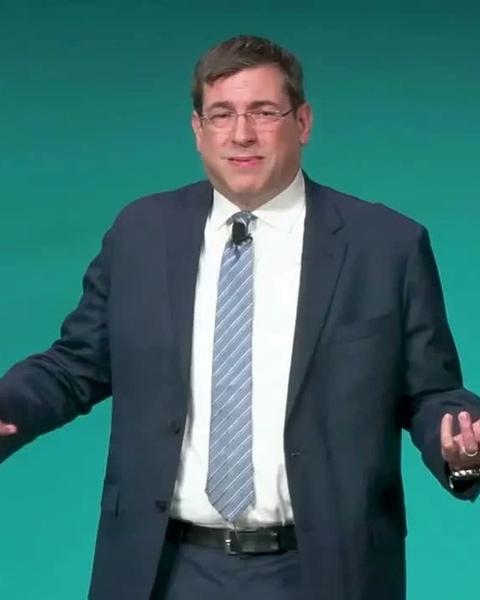
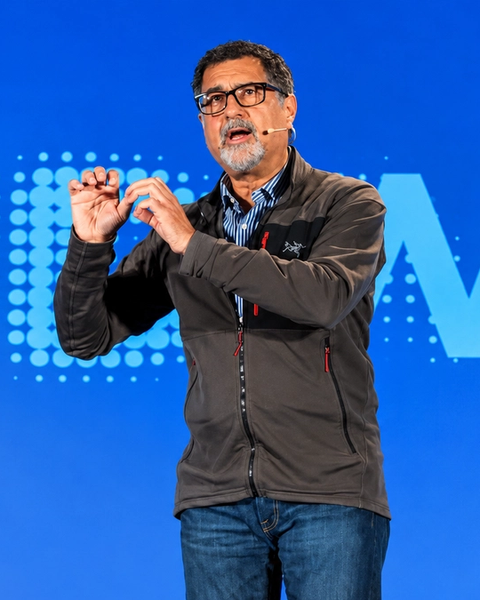
It’s been said that human innovation is at its most powerful when it springs from compassion. For Mark Ganz, CEO of Cambia Health Solutions, seeing his mother’s wishes not met at the end of her life fired his passion about the role of health care, and the transformation required to recreate an intertwined network of care centered on the needs of people and their families throughout the cycle of life – from birth to its natural completion. Mark closes the day with a challenge to let our humanity guide us as we shape health care to support what we want most for ourselves and for the people we love.

December 7, 2017
Transcript
She was eight years old. For today, I’ll call her Clara.
Clara was dying of cancer. Her curative treatment had come to an end, and her parents had decided to discharge her from Doernbecher Children’s Hospital, part of OHSU in Portland, Oregon, and return home to Southern Oregon so she could live out her final days in her own room, surrounded by her toys, stuffed animals and family.
But there was a problem.
They got home, and everything looked great. Then Clara wouldn’t go to sleep. Night after night, she would get close to falling asleep and then wake up.
Her parents were puzzled and worried. Maybe it was related to the cancer overtaking her body. Maybe it was a side effect of her pain medication.
They called Cathie Perko, a nurse practitioner at Doernbecher and a very dear friend of mine going all the way back to high school. They explained what was happening and asked what they should do.
Cathie’s initial inclination, her autopilot response, was to think, “There’s a drug for that.” Maybe they could give Clara sleeping medication. Maybe they could increase the narcotics enough to calm her so she could sleep.
But in a moment of insight, Cathie stopped herself.
She asked the parents, “Have you asked Clara why she won’t fall asleep?”
They said, “No, we haven’t.”
Cathie said, “Take the phone into her room. Bring me with you, and let’s ask her.”
They went into the room and asked, “Clara, why aren’t you falling asleep?”
Without hesitation, Clara said, “Because I’m afraid death will come for me while I’m asleep.”
They finished the conversation with her, left the room and continued talking with Cathie. Together, they came up with the idea of getting Clara a pair of little angel wings.
Later, her parents returned to the room with the wings. They told her, “Wear these so that if you go to sleep and death comes for you, they will carry you to heaven.”
She wore them for the remainder of her days, and she slept soundly every night.
Sometimes, as we have heard from many people today, the healing thing is not a medical thing.
Perhaps the most profound lesson I take from that true story is that finding the right answer began with asking, even asking an eight-year-old girl what was really happening to her.
Because they asked, they discovered what was truly going on and were able to create a response tailored specifically to her.
At my company, we have spent the past 14 years trying to disrupt ourselves. We are a 100-year-old company, and we have worked to disrupt our own business model because we deeply believe in fundamentally transforming the experience that individuals and families have within healthcare.
We know we cannot boil the ocean, so we have chosen specific experiences to transform. The experiences of children, adults, families and caregivers going through serious illness and facing the end of life are worth our time and creativity.
We have learned a great deal in the process. Some of these lessons probably won’t surprise you.
Ninety-seven percent of Americans want palliative care once they understand what it is. When have 97 percent of Americans ever agreed on anything?
The vast majority of physicians and nurses want palliative care for themselves when they are facing serious illness. Yet 46 percent of physicians feel unsure or unprepared to have these conversations and apply palliative care to their own patients.
Seventy percent of Americans want to die at home, but only 30 percent actually do.
Four in 10 people are caring for, or have cared for, a parent. As we heard just a few moments ago, caregivers are essential to this work.
Patients do not want to wait until they are declared to have only six months to live or be forced to give up curative treatment to receive Medicare reimbursement for palliative care.
That law must change.
Here is what I think: We need to light the fire of a social movement around changing the end of life. That is the challenge I believe we should take away from today.
Several years ago, I had the honor and pleasure of having dinner with the wonderful Ellen Goodman, who was a columnist for many years and is now the founder of The Conversation Project. Many of you know the work it does in this space.
We were discussing The Conversation Project before it launched, brainstorming ideas, when she asked me, “Mark, tell me what it was like when you were born.”
I said, “I don’t actually remember that.”
She said, “What was it like for your mother? What was the experience?”
I said, “My understanding is that she was in a surgical suite under general anesthesia. My father, who was a family doctor, was in the waiting room smoking a Camel cigarette. She had no memory of the actual birth.”
I was the youngest of six, and she had been under general anesthesia for all six births. That was the norm.
Ellen then asked, “What was it like when you had your own children?”
I said, “We were in a comfortable room. There was a stereo, soft lighting and a birthing chair. I was there. My sister was there. It was a great experience.”
She said, “Exactly.”
That experience was not invented by an academic at Harvard University. It was not invented by the National Institutes of Health or created by a venture capital firm in Silicon Valley.
It was created by mothers, mostly mothers and some fathers, who demanded something better.
The birthing movement of the 1960s and early 1970s completely changed the landscape of birth in this country.
Through another social movement, we can create an experience at the end of life as good as the experience we created for the beginning of life.
That is a task worth taking on.
Every one of you in this room is a leader in some way, wherever you are within your organization or community.
When we strip away all the leadership jargon, what are the essential ingredients for driving transformational change and disrupting a system that is producing suboptimal results?
For me, it comes down to three questions. I encourage you to ask them of yourself in the first person.
The first question is: Do I have hope?
Do I have a deep, fundamental hope that lights a fire in my belly? Do I believe the end-of-life experience can be transformed through human-centered design and personalized according to the needs and desires of every individual and family?
This is not an idle question.
I think one reason things have not changed as much as we would like is that there are not enough people in leadership who have hope. They simply keep doing what they are doing and call it good enough.
Do I have hope?
When you can answer yes, you reach the second question: Do I believe I have the power to drive this change?
I don’t mean that I have to do it alone. I mean: Do I believe I have something to give? Can I be the change I want to see?
This is not an idle question either.
Many people say they have hope, but then say the hospital administration needs to change, health insurers are not doing their part or a new law needs to pass.
They pass the responsibility along. They have hope, but they believe someone else has to act.
That does not get the job done.
When you can answer yes to the first two questions, you reach the truly difficult one:
Am I willing to risk everything to achieve it?
Am I willing to risk my livelihood, my comfortable existence or my job because this work is so important? Am I willing to accept the challenge and pursue it with as much urgency as I can muster?
The speakers we have heard today are living in a state of yes to all three questions. Every one of them has been incredible, not simply talking, but acting.
I wrote down some of the themes I heard today. I probably won’t capture everything, but several ideas kept returning.
First, death is a human experience, not a medical one. The only way to create something better and transform the experience is to begin with the human beings involved.
Second, the definition of palliative care we heard this morning is what healthcare in America should be. It is worth pursuing, and it is within our grasp.
Third, healing is the goal, not only curing.
I learned that long ago from my father, who was a family doctor. He understood that his job was to bring about healing, even when he could not bring about a cure.
Healing could come through how he treated the patient and their family and through creating a meaningful experience, even when that experience involved saying goodbye.
Fourth, ask me. Don’t assume.
It seems so simple, yet healthcare finds it so difficult.
Its close cousin is: Design with me. Design for me based on what I tell you. That is human-centered design.
Embracing our fear of death and developing a deeper understanding of it can teach us how to live well. That is something I will be thinking about for a long time.
Colored candies are great teachers. I’ll take that one with me too, although I admit I was hoping she would throw some candy into the audience.
And then there is urgency.
Every day and every hour we fail to act, people are suffering. People are not receiving the end-of-life experiences they should have.
Pondering that alone should cause us to race out of here with fire in our hearts.
Finally, as I have said before, I truly believe that our investments of time, creativity and financial resources in this field must be directed toward a return on humanity.
This is not about a return on investment. When we do the right thing for individuals and their families, the financial side will take care of itself. But money is not the reason to pursue this.
To borrow a phrase from a past presidential campaign, it’s about the culture, stupid.
When you think about the challenge we face in designing and implementing something different, imagine someone coming to you 20 years ago and asking to see your cellphone.
I would have pulled out a slightly heavy Motorola flip phone with a strange antenna that slid in and out and always broke.
Imagine they asked, “How could we create the most extraordinary cellphone experience possible, one that meets all your needs?”
My answer would have been shaped by what I knew, or thought I knew, about cellphones.
I would have suggested making the antenna more durable, increasing the range, waterproofing it, making it more shock-resistant and extending the battery life.
I seriously doubt I would have described an iPhone.
That is our challenge.
We live within a culture that limits us through the assumptions we make. We need to figure out the iPhone of end-of-life care rather than simply trying to build a better Motorola flip phone.
It is not easy.
Let me tell you what cultural signals can do and how they can harm people.
My mother had congestive heart failure. My father had died in 2003 from multiple myeloma.
He had a beautiful end-of-life experience at home, with incredible hospice workers helping him and our family move toward the moment when he crossed over.
It was the most spiritually powerful and rich experience of my life. It was a thin place where I could see the divine in the moment his spirit left his body.
Five years later, my mother had experienced a series of crises related to congestive heart failure.
Those of you familiar with congestive heart failure know how it goes. Things remain steady for a while. Then there is a crisis and a step downward. Things stabilize again, followed by another crisis.
You never really get better. You remain steady until the final crisis.
Every time she went into the hospital, we did not know whether that would be it. Eventually, we almost assumed she would make it through because she had made it through before.
But we also knew.
She went into the hospital on November 15, 2009, and things began going downhill. I wasn’t in Spokane, where she lived. I called my brother, who was a physician there and had seen her.
I asked, “Do you think I should get on my horse and come up there?”
He said, “No, I think it will be all right. I think this is just another one of those episodes.”
But it was not all right.
Later that evening, my two older sisters arrived and spent some time with her. I don’t think they believed she was about to die either.
My mother had a wonderful perspective on life. She wanted to live until she took her final breath.
She was not preparing to die, but she was at peace with it because of her faith. She missed my father and was okay with death whenever it came.
But one thing was extremely important to her. When her heart stopped, she did not want anyone to try to restart it.
She believed that when her heart stopped, she was ready to go.
Every time she entered the hospital, she insisted that her signed do-not-resuscitate order be placed in her medical record and on the door of her room. Maybe she should have had it tattooed on her.
My sisters were with her and became hungry. They asked, “Mom, can we go downstairs to get some food? We’ll be back soon.”
She said, “Certainly. Go ahead, Caroline and Katie. That’s fine.”
They left to get food.
Minutes later, my mother’s heart stopped.
The hospital performed a full code.
She did not come back. My mother was a strong-willed person, and we felt deeply blessed that she did not. But we were angry with the hospital and its staff.
We asked them, “What were you thinking?”
They were good people. It was a good hospital.
The problem was culture.
The culture of the hospital and the people working there said that if someone died during your shift, it was a bad thing, almost a black mark against you.
Extending life meant it had been a good day. Dying meant it had been a bad day.
That culture caused them to go on autopilot. They did not stop, look at the order or honor my mother’s wishes.
Culture is powerful.
When you return to your workplaces, I urge you to become a beacon for cultural change. That takes courage and perseverance.
We are a 100-year-old company, and we have been working on this for 14 years. From the beginning, I knew this was not primarily a strategic challenge. What needed to happen seemed fairly straightforward.
I knew it would be a cultural challenge, and it has been.
The good news is that we have made enormous progress because we have been relentless.
Here is what I ask you to take with you as you leave for drinks and then return to your work and families.
Let us resolve, here and now, that situations like these will no longer happen because of the work we do.
Let us ensure that they do not happen. Let us refuse to tolerate even one more bad experience.
Every one of us needs that level of resolve and commitment if we are going to become examples within our organizations and drive real change.
Let us make the end of life what it should be, what we want it to be and what we know the people we serve want it to be: a human, healing and sacred experience for individuals and the people who love them.
I urge you to go forward from this place with courage born from deep hope and with the belief that you have the power to drive the change you want to see.
Good luck.
RELATED