Fear of Needles: Preventing and Treating Pediatric Pain
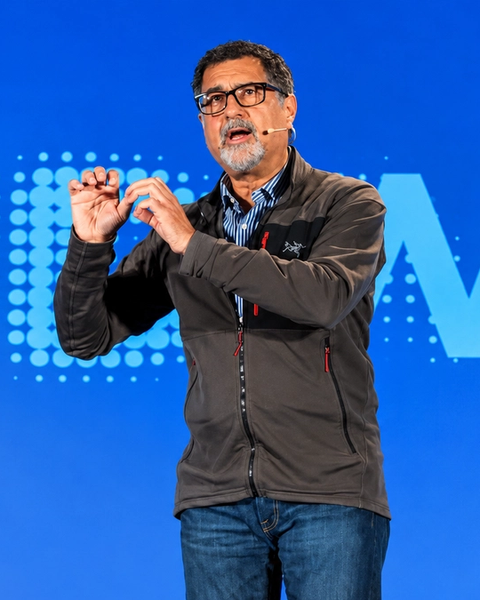
In healthcare, pain, even among children, is frequently seen as an unfortunate byproduct of treatment. Stefan J. Friederichsdorf MD, FAAP firmly believes this shouldn't be the case. Learn how as the medical director of the Stad Center for Pediatric Pain, Palliative, and Integrative Medicine, he blends modern techniques with timeless treatments to minimize pain. Topics: Pediatrics, Children's medicine, Pain, Needles, Innovation.

November 16, 2023
Transcript
Good morning, lovely people. I’m so happy to be here. Take a big breath. There’s a lot happening, and I’m very happy to talk about pediatrics.
To explain what is happening today in 2023, let’s go back to 1985. Half of you are too young to remember that, of course. But for those who do, this was Back to the Future. This was The Goonies. These were all the groovy movies.
In 1985, a little baby named Jeffrey Lawson was born prematurely on the East Coast of the United States. Unfortunately, he had a heart defect. He needed to gain a pound or two before he was old enough to have surgery. He was transferred to the largest children’s hospital in Washington, D.C., and underwent heart surgery.
In 1985, that was a big deal. Jeffrey needed to be cut open from here to there. They opened his ribs, operated on his heart and closed him up again.
Unfortunately, Jeffrey died a few days later.
His mother, Jill, was grief-stricken. She didn’t know what to do. She met with her friends, and one of them, a nurse, said, “I’m worried. I don’t think Jeffrey received any pain medication.”
Jill said, “What?”
She ran back to the hospital and looked through his charts. Jeffrey had not received any pain medication during the surgery. In fact, he had not received any anesthesia. He was fully awake while he underwent surgery.
Jill went to the hospital leadership and the head of anesthesiology. She asked, “How did you do this? How could you possibly operate on a child who was fully awake, without anesthesia or pain medication?”
She essentially received a version of, “Woman, calm down. This is how we do things.”
In 1985, it was standard care in the United States to operate on babies while they were fully awake, without anesthesia or analgesia.
We’ve gotten better, a little bit.
This is no longer happening in the operating room, but we need to talk about what happens afterward. Many of the clinicians you are dealing with today were either around in 1985 or were trained by people who were. That explains a lot of what is happening.
This is an End Well conference. My wife and I have three children, who asked me, “Do you have to get a selfie with Yvette?” So I will send them that afterward.
I had breakfast with them. Then they went to middle school and high school. I hope they will do something useful. Hopefully, they will go to college, become a plumber, an actor or a painter. I hope they will be happy.
And I hope my wife and I will die before our children.
At this very moment, 375,000 families in the United States do not have that privilege. There are 375,000 families looking at their child and worrying that the child may die in a day, a week, a month, a year or 10 years from now.
In other words, there are more than 560 Boeing 747s cruising through American airspace right now, full of children with life-limiting diseases.
Every five days, one Boeing 747 full of children crashes over American airspace.
I assume that when you flew here yesterday, you would not have chosen an airline that loses a Boeing 747 every five days.
That airline is called the American healthcare system.
As a specialist in pediatric pain, palliative care and integrative medicine, I need to look families in the eyes. Our interdisciplinary team of nurses, social workers, psychologists, doctors and nurse practitioners needs to say:
“I promise you that when the worst thing imaginable is happening, when your child is approaching the end of life, your child will not die in pain. I promise you that your child will not live with breathlessness, nausea or vomiting. I promise you that we will care for you and the healthy siblings.”
That promise is not being made in 2023.
Most hospitals have only one or two clinicians providing a very small palliative care service. Ninety percent of children today die without ever seeing a specialist like me or an interdisciplinary palliative care team.
We need to do better.
A few months ago, I was invited to meet Sophia, who was critically ill in the intensive care unit. She had a severe heart defect.
I introduced myself to her mom and asked, “How can I help you? Tell me about Sophia on a good day.”
She told me about her daughter. She showed me pictures and videos of what Sophia was like. She also told me that Sophia had not had a good day in a very long time.
I asked about her understanding of what was happening. Then I asked the single most important question in palliative care:
“Considering what Sophia is up against, what are you hoping for?”
She said, “I hope for a miracle. I hope for a cure. I hope that, as a parent, I am not failing and that I have left no stone unturned in caring for my daughter.”
I said, “You are an amazing parent, and I hope for those things too. I have three children, and I have no idea what you and your husband are going through.”
Then I asked, “Is there anything else you are hoping for? In case the miracle cannot happen and the cure does not come, is there anything else you hope for?”
She said, “Yes. I want to make sure she is not suffering.”
Then she looked at me and said, “I wish I could hold my daughter one more time.”
I looked at the nurse and asked, “How long would this take us?” Sophia had tubes and equipment everywhere.
The nurse said, “I don’t know. Five minutes.”
She lied. It took about five minutes and 30 seconds.
But we got it done.
Six minutes later, this mother was able to hold her daughter for the first time in many weeks.
Our interdisciplinary team then began working with the family. We improved Sophia’s pain and symptom management using effective medications, along with hypnosis, biofeedback, aromatherapy, acupuncture and acupressure. That is what we do through an interdisciplinary pain, palliative care and integrative medicine system.
We also began caring for the family and Sophia’s siblings.
About three and a half weeks later, Sophia was able to die comfortably in her family’s arms.
That is what we call ending well. That is what we need to do.
I have the privilege of sitting in front of Elissa Storch, who helped fund our Stad Center at UCSF Benioff Children’s Hospitals, where we combine pediatric pain, palliative care and integrative medicine.
We need this at every children’s hospital.
We need it today, and we need it beyond San Francisco and Oakland. We need it in every children’s hospital in North America and every children’s hospital in the world.
Now, changing topics, how many of you have children?
How many of you know a child?
How many of you have been a child?
You are my audience.
If I went to your city right now and asked every child, “What are you most afraid of when you see the doctor?” what would they say?
Needles.
That is the number one source of suffering for children. We have published research showing that even children with serious illnesses, after bone marrow transplants or heart surgery, say that needle pain was the worst part.
We developed something called a Comfort Promise. We can almost completely eliminate the pain and anxiety caused by needles, including vaccinations and blood draws.
Children still need those pokes and jabs, but they can be virtually painless.
How do we do that?
We apply numbing cream. We stop holding children down. We use distraction. Babies and infants can be breastfed or given sugar water during the procedure.
This is not rocket science. It is very straightforward, and we have shown it to be effective.
Recently, I helped implement this approach in four low- and middle-income countries in South America, sub-Saharan Africa and Southeast Asia.
What I did not know was that most children with cancer in those countries die. Here in the United States, more than 80 percent survive.
What is the difference?
Children in lower-income countries may have much more advanced cancer by the time they reach the hospital. Their parents may live in poverty, 800 miles away, and may not be able to continue bringing them in for treatment.
One of the leading reasons children stop cancer treatment in low- and middle-income countries is fear of needles.
Two weeks ago, I attended the largest pediatric cancer conference and spoke with many parents. They explained that when their children enter the hospital, there are often no central lines.
Every time the child needs blood drawn, they have to be poked. Then they are held down so someone can establish IV access. Chemotherapy begins, the vein stops working at three in the morning, and a medical student tries 17 more times to insert another IV.
This experience can become so awful that children and parents decide not to continue treatment.
Even here in the United States, many people forgo medical care because they are afraid of needles.
I’m not going to ask you to raise your hands, but about one in four people is extremely afraid of needles. That means there are hundreds of people in this audience who do not like them.
I invite you to join me in the Ouchless Jab Challenge.
We need to make sure that we can make this promise to every child, every time, everywhere:
We will do our very best to prevent the pain and anxiety caused by needles.
Today, in 2023, this is one of the greatest healthcare problems facing children in North America and around the world.
If we wait for the healthcare system to change it, we will still be talking about it in 50 years.
Please think about what you can do in your own life to spread the word that this can be done today, for every child, every time, everywhere.
I will be around all day. Please join me at lunch so we can talk about this and consider what you might personally contribute to spreading the word and supporting this work, so it happens now rather than 50 years from now.
Thank you for listening. Make me proud.
RELATED