What Living on a Dementia Ward Taught Me About Being Human
At 21, Teun Toebes made a decision that would change the course of his life.
He moved into a locked dementia ward and lived there for more than three years, not to study dementia from a distance, but to experience daily life alongside people living with it. What he found challenges many of the assumptions we carry.
In this talk from the End Well 2025 stage, Teun shares what it means to truly see the people behind a diagnosis. Through stories of friendship, connection, and care, he invites us to reconsider the way we think about dementia and the systems built around it.

November 20, 2025
Transcript
At the age of 21, I decided to live voluntarily on the closed ward of a nursing home for three and a half years, together with people living with dementia.
I made that decision because I am deeply concerned about the way we see dementia and the way we treat people living with dementia within our healthcare system.
I had worked in healthcare, and I still do. After four years in a nursing home, I asked my colleagues, “Would you want to live here yourself?”
Almost all of them said, “Hell no. If I get dementia, I want to live differently.”
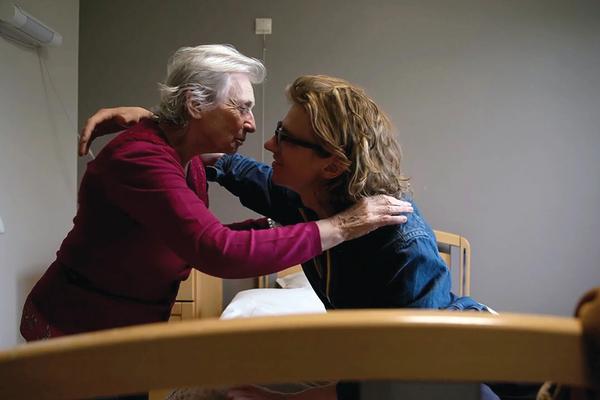
So I moved into a closed dementia ward to understand people living with dementia more deeply. I did not want to confirm my assumptions or my own stigmatized view of dementia. I wanted to listen to people like Ellie, the woman you see here.
Although I shared my bathroom, toilet and living room with my housemates, I had one enormous privilege.
I knew the code to the door of the closed ward.
The code to freedom: 201.
I was allowed to go outside. I could still meet my friends. I could visit a supermarket.
I was still connected to society.
When I returned one day, a caregiver said, “Teun, could you please be less close to Ellie? She feels sad when you’re not here.”
On one hand, I completely understood that reaction because it is difficult when someone feels sad.
But on the other hand, isn’t it beautiful that a 92-year-old woman is still able to feel sadness?
That someone is allowed to feel lonely or insecure when you are not there?
That you are still allowed to build a relationship and love one another? That when you are together, you can feel secure and seen?
Are people living with dementia allowed to experience the same emotions we all experience in our daily lives?
Are they allowed to be human?
That is why I believe so strongly that our human view of dementia, the way we look at it, is the key to a better future for all of us.
A better future for people living with dementia is, above all, a better future for everyone.
Looking differently always leads to acting differently.
The way we see and perceive dementia forms the foundation of our healthcare system. If we change that view, we will also change the system itself.
I strongly believe that dementia is not fundamentally a care problem. Dementia is a societal issue.
Why do I say this?
I am not here to blame nursing homes. The way we have organized healthcare and nursing homes reflects the values of our society.
I want to show you one concrete example. I get goosebumps when I speak about it because I lived here for three and a half years.
This is the closed ward where I lived.
You may be thinking, “You’re from the Netherlands. This looks like a nice care environment compared with ours.”
But who wants to live in a care environment?
You do not want to live in a care environment.
What we see here is a closed ward. The fact that closed wards exist is the ultimate example of the stigma surrounding dementia.
When someone walks outside, we often call it “wandering.” We assume that if we open the doors, everyone will walk out.
I am hopeful because more than 500 organizations in the Netherlands have opened their doors. Closed wards are no longer the legal standard.
Creating change is always about policy, society, the way we see dementia and how we change the narrative from the foundation of our society.
If we look again at the photograph of the closed ward, you can see an experience screen on the left. For me, it is a perfect example of how we often approach improving healthcare.
Especially in America, I can say as a European, but also in the Netherlands, we believe we can buy everything. We believe that adding more products will improve quality of life.
In the photograph, you can also see stuffed animals attached to the wall, a fake rabbit and a fake cat.
The idea is that my housemates, people like you and me, can take one down from the wall and carry it with them, giving them a sense of autonomy.
May I ask you something?
Who has stuffed animals attached to the walls of their home?
We are creating artificial environments.
We should not do that.
When changing society and improving the quality of life of people living with dementia, please do not simply copy other countries.
Do not copy the Netherlands either.
This is not about building more nursing homes. It is also not about copying dementia villages, because that can become another version of the same system of exclusion.
We have to be careful that we do not create separate societies for people with a diagnosis and people without one.
That is one of the most painful things we could do while claiming to build an inclusive society.
I want to take you with me onto the closed ward.
You can see my housemates on the screen. On the left is someone who became a very good friend of mine. Next to me is Ellie again, and you can also see Tina.
During those years, I built wonderful friendships with them.
We ate together. We sat beside one another. We drank together.
By the way, as a former nursing home resident, I am happy that I’m allowed to drink water. Normal water.
Although the water in America tastes very different. It is full of chlorine.
But apart from that, I truly began to love the people I lived with.
I never expected that because I also had a very dark view of dementia.
On one hand, I experienced this deep sense of relationship.
On the other hand, I also experienced what our care system does to people, because I had also been educated through a medical lens.
I saw the effects of that system on my housemates.
I would sit with someone at the table, and if they were at risk of choking, an incident report would be filed.
Someone whose job involved quality control would analyze the report. The person might then be referred to a speech therapist, who would conduct a risk assessment.
If the person was considered at greater risk of choking, they might receive thickener in their drink.
I’ll give you two more examples because I love these examples.
If you are at risk of falling, we might send an email to a physiotherapist.
The physiotherapist arrives and conducts a risk assessment. If you are considered at greater risk of falling, you might receive a walker, a wheelchair or the newest innovation in the Netherlands, a hip airbag.
Another example: What happens if you are at risk of not eating enough?
May I ask who sometimes feels stressed?
Who starts eating more when they feel stressed?
And who starts eating less?
Imagine that you feel stressed in a nursing home because it does not feel like home. Because of that stress, you stop eating enough.
We write down, “The person did not eat.”
Your family members and loved ones read what was documented, and they begin to worry. They call and ask, “Can you do something else? Can you do more?”
We sometimes feel powerless, so we email the dietitian.
The dietitian arrives and conducts another risk assessment.
If you have not eaten enough, we say that you have “lower intake.”
Then you may receive a small white bottle containing a protein drink.
My message is not that speech therapists, dietitians and physiotherapists cannot be useful.
My message is also not that these products cannot be helpful.
But the poverty of our wealth is that we add specialists and products to people’s lives without first asking them, “What do you want? What do you need to have a good life and experience quality of life?”
We live in such a wealthy world that, unless we ask ourselves these ethical questions, the system will automatically place products and professionals around people.
But are we actually helping them live a good life?
I think we can do things differently, and I have seen beautiful examples.
This is an example from Denmark, with real plants, real dogs and a living environment.
We cannot expect people to feel alive when we create a dead environment.
They had real dogs. They did not call them therapy dogs. They were simply dogs.
This was in Slovenia, in a place that felt like a home.
When we create a home, people often do not want to leave.
Residents were allowed to bring their own sofas, without plastic coverings. Just normal sofas.
When possible, they could bring their own beds.
Beautiful.
Here is another example from Belgium, the country just south of the Netherlands.
I think this illustrates what care can be.
This person may have been feeling a little restless. A caregiver approached her and played her favorite music. Then the caregiver lay down beside her on the bed.
I am not saying everyone has to do this.
But this can also be at the heart of good care.
This example of Janet is also from Belgium.
She was living in a brand-new nursing home with a strong architectural vision, but she had been staring at the ceiling for months.
I was standing in the doorway, and I sensed that she was responding to me.
Maybe you recognize that feeling. I could feel it.
I entered her room and saw that she was religious, that she was Christian. She had a cross above her door and a small prayer card beside her bed.
I picked it up and began reading.
The moment I started reading the prayer card, her foot began tapping to the rhythm of the words.
She is here.
She has an identity.
We can see her. We can listen to her.
But we can do that only if we break with the stigma surrounding dementia.
Of course dementia can be incredibly painful. I would not wish it on anyone.
But what I learned from my housemates and the people I met is that the most painful part is often the way society treats people living with dementia.
The social isolation. The stigmatization.
And we can change that.
I want to give you one final example.
This was a campaign from the Dutch Alzheimer’s Association during World Alzheimer’s Month last year.
These are photographs of people living with dementia, most of whom were still alive, portrayed as though they were dead.
The text says, “Dementia makes you lose yourself and each other.”
When this is the message coming from organizations that claim to represent people living with dementia, we create the stigma ourselves.
I am not saying that dementia cannot involve loss.
I lost my own grandmother this year, in part because of her dementia.
But organizations in our society have an institutional responsibility. They do incredibly important work, and we need them to be part of this change.
But they also have to change.
If we want to dismantle these views, everyone is needed.
And if you are religious, if you believe in God, stigma is not something God gave us.
It was not created during the Big Bang either.
It is a social construct, and we can change it.
So, dear people, dear Americans, please remember:
Only when we continue to see the human being will they never disappear.
Thank you.
RELATED