Who Gets a Say in Our Care
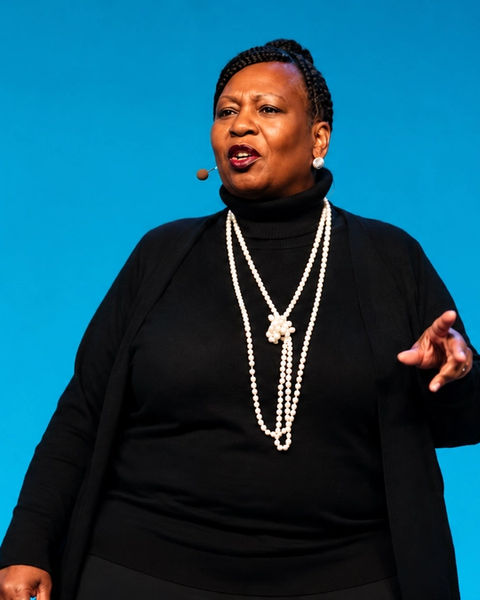
Shouldn’t patients know exactly what treatments are available for their diagnosis, asks Meg Gaines. Meg found out what happens when this vital exchange of information between patient and physician is missing the day she was diagnosed with ovarian cancer.

December 6, 2018
Transcript
I’m actually really glad to be here, and relieved. Jessica’s presentation was a perfect example of why.
The work I do has allowed me to be with many people as they turn to face their death, and even as they take their final breaths. Although this is always a sacred experience, I don’t often get the chance to talk about it.
I run a nonprofit, a 501(c)(3), and funders don’t often want to hear about how you helped somebody die. They mostly want to hear about how you helped somebody survive against the odds.
People like me.
When I was 38 years old, I was diagnosed with ovarian cancer, which soon metastasized to my liver. I was told to go home and think about the quality, rather than the quantity, of my remaining days.
My children were three years old and six months old.
By now, you’ve probably figured out that I did not go home and simply think about the quality of my remaining days. I learned to advocate for myself and found an experimental, risky treatment that saved my life.
Now, well, see for yourselves. As you might imagine, I’m a mess at my children’s graduations. But I’m there.
I realized pretty quickly that I had nearly every form of privilege our society can offer. I had everything that could be bestowed upon me, and still, the path to survival was harrowing and terrifying.
It turns out that immediately after a diagnosis is not the best time to learn how to advocate for yourself. But that is when most of us do.
Whatever the outcome of a diagnosis, we all want the best chance we can get to live, to live well and, when it is over, to die well.
That is harder than it sounds for many reasons. But one fundamental reason lies at the core of all the others: It’s complicated.
Someone once mistook this image for a Disney ride.
If it is true that every system is perfectly designed to produce the results it gets, then it is worth asking what our system is designed to produce.
It is certainly not designed to prioritize health or caring.
There are exceptional healthcare providers, truly exceptional people, bringing their whole selves to care for us every day. But our healthcare system works against them.
Health and caring are not rewarded or encouraged by the business model. They often create trouble for the people who prioritize them.
Is it because we don’t spend enough?
No.
We spend almost twice as much as the next highest-spending country, Sweden. They spend about $5,600 per person compared with our $9,600, and they provide care to everyone.
We still have 28 million uninsured people in this country.
With an investment this enormous, soon to reach 20 percent of GDP, the focus remains on business. For-profit and nonprofit organizations alike are obsessed with RVUs, relative value units, and what they can bill for a service.
Procedures, surgery, scans and radiology generate high-density RVUs. The clinicians who perform them are well rewarded, financially and in terms of how they are valued within their organizations.
Time with patients is the least lucrative, so it is valued least by the people tracking revenue.
That is why we have to put up a massive fight across the country, most recently in Wisconsin, where I come from, to gain approval for a single 30-minute consultation at the end of life.
One 30-minute consultation at the end of life.
Think about that.
There must be an upside, right? If we spend this much, we must have the healthiest population on the planet.
We don’t.
Unless you think ranking 34th among the healthiest countries, nestled between Costa Rica and Croatia, is cause for an end-zone celebration.
We are also tied with Azerbaijan at 55th out of 56 countries for healthcare efficiency. The least efficient is Bulgaria.
Our error rate is abysmal. Estimates suggest that between 200,000 and 400,000 people are killed by healthcare every year. That is equivalent to one or two fully loaded jumbo jets crashing every day.
We injure another two to four million people each year.
Then there is waste. Conservative estimates suggest that we waste one out of every three healthcare dollars. Some estimate that as much as half of what we spend is wasted.
When we talk about waste, it is not simply dumped in the garbage. It often passes through our bodies first, sometimes with significant consequences.
At least the people working in healthcare must be doing well, right?
No.
We are harming and even killing our healthcare practitioners. Burnout, drug and alcohol misuse and suicide are far too common among physicians. They have the highest rates of all three among professionals.
If every system is designed to produce the results it gets, ours is designed to produce healthcare widgets at a profit, at the expense of human beings, patients and clinicians alike.
Perhaps just as insidious, this fundamental focus on profitability prevents us from concentrating on the real problems, the difficult ones we need to address as a nation.
Other industrialized countries have created healthcare systems designed to support health and caring. That doesn’t mean they have no problems. It means they are focused on the right ones.
Disease prevention, including developing new vaccines and treatments. Identifying and reducing environmental toxins in our food, water and air. Addressing the health effects of poverty, racism and limited access to education.
That is where our money needs to be spent. Those are the difficult issues we need to address before it is too late.
To do that, we must change the relationship between clinicians and patients from one of delivery, which describes a unilateral transaction, to one of co-creation.
Together, we can build a sacred relationship dedicated to maximizing the potential for a healthy life and a comfortable death.
UPS delivers. I don’t even have to be home to receive it.
Co-creation describes a collaboration in which we share responsibility for my health, and in which the clinician and patient openly plan for my eventual death.
We normalize death because, well, it is normal.
Co-creation requires fundamental changes from clinicians and patients, what we used to call a paradigm shift.
It requires honesty and courage to discuss what is true and contemplate a realistic future.
It requires an appropriate allocation of responsibility for my health and healthcare, which means some of that responsibility belongs to me.
It requires intentionally leveling the playing field of knowledge and power, creating a process in which patients can and must learn what we need to know to make decisions that reflect our values and priorities.
It also requires a healthcare system that prioritizes health and caring.
How will we get there?
We can begin by educating clinicians and patients in the essentials of co-creation: partnership, shared responsibility and compassionate candor.
Patients need useful materials that help us learn what we need to know to participate fully in our care. We do not need generic brochures. We need precision information to accompany precision medicine.
Twenty-five years ago, when I was diagnosed, I printed reams of paper from the brand-new internet. Believe me, it took much longer then.
I researched and researched and brought in 250 pages about liver cancer.
But I didn’t have liver cancer. I had ovarian cancer that had metastasized to my liver, which is completely different.
How was I supposed to know that?
This is just as likely to happen today as it was 25 years ago.
The information age needs to reach healthcare in a way that benefits patients and improves our decision-making.
A simple solution would be to give every person diagnosed with cancer a sheet automatically generated by the electronic health record. Imagine that, something useful coming from an electronic health record.
It could list the exact diagnosis, stage, grade, cell type and known mutations. It could also provide several websites that clinicians consider valuable resources for patients.
That would be much better than simply saying, “Don’t go on the internet. It’s a bunch of garbage.”
We should be well beyond warning patients away from the internet. We cannot resist its flow, and we are foolish to try.
The internet is a valuable tool for co-creation and for educating patients and clinicians. We must step into that river and learn how to navigate its dynamic waters together.
Clinicians need precision information too, along with an educational process that prioritizes human values and self-care as highly as clinical knowledge.
We could begin by requiring a course every semester addressing the role of touch, hope, honesty and compassion in being with patients and families through grief, fear, sadness and anger.
This must become as important in the education of health professionals as more measurable skills and knowledge.
Albert Einstein taught us that not everything valuable is measurable, and not everything measurable is valuable.
We must also acknowledge from the beginning of medical education that clinicians are human and will therefore make mistakes. It is called human error for a reason.
A course or two on how to recognize, think through, discuss, acknowledge and apologize for mistakes would be valuable.
We also need protection from punishment for honest mistakes, the things we wish we had done differently once we had the benefit of hindsight.
We make what appears to be a rational decision and later discover that we were wrong. There is so much we cannot know in advance.
Unexpected outcomes are part of life, including medicine.
We need to abandon the fiction that excellence means never making mistakes, and that mistakes or unwanted outcomes must always result from negligence or some other human failing.
We need to address the underlying causes directly and prioritize patient safety and clinician well-being.
We can and must do both.
Clinician wellness must become a fundamental priority for our healthcare system.
If Newton were alive today, I know he would be happy to add another law of physics: You cannot give what you do not have, at least not for very long.
If my doctor is not happy and healthy, she will not be able to co-create those things with me.
Or, as we say in Appalachia, if Momma ain’t happy, ain’t nobody happy.
Patients will not be safe until our clinicians are safe. It is as simple as that.
We need to place the highest priority on teaching future clinicians the importance of self-care and the science supporting it.
Yes, these priorities will require us to reframe, revise and reform healthcare so that it actually becomes a system, one that enjoys the advantages high-performing systems can provide and focuses on health and caring.
That sounds simple.
It is simple, but it is not easy.
Profit is a fierce opponent. But any chance we have will come from patients and clinicians joining together in a radical re-creation of healing, which lies at the foundation of our sacred relationship.
Thank you.
RELATED