What It Takes To Create Better Healthcare Policy
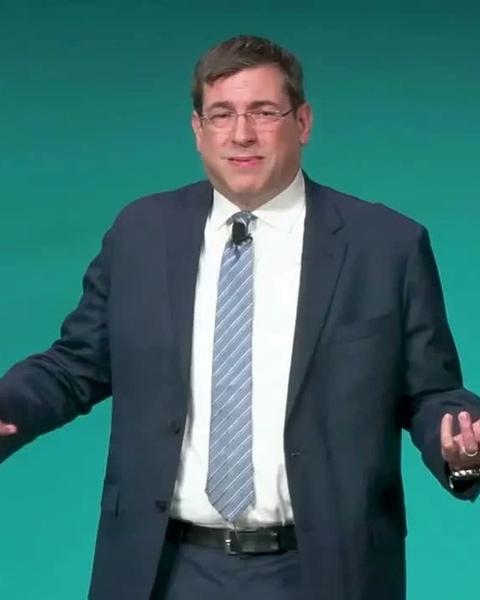
What would it take for everyone in Massachusetts to get care that honors their values, preferences and goals—throughout their entire life? This question animates healthcare visionary Andrew Dreyfus whose personal experience of death gone well led him to become a leading advocate for fundamentally changing the way we care for people—and their families —facing serious illnesses. Deeply committed and enduringly optimistic about our shared responsibility to improve not just healthcare but health, Andrew shares learnings and insights into ways to create and sustain social change.

December 5, 2019
Transcript
We often try to keep our personal and professional lives separate, but sometimes those two worlds collide in unexpected ways.
That is what happened to me.
By day, I am the CEO of a nonprofit health plan that provides insurance to almost three million people. But when I leave the office and peel off my CEO role, I am a patient and a family member.
I want to share my journey as a family member, a journey that led me to join a movement in Massachusetts and beyond that is asking some uncomfortable questions about the healthcare system.
What if our approach to end-of-life care has been misguided? What if we are using the wrong language? What can we learn from other major social and public health movements?
And what if, this is the big question, we changed our approach to end-of-life care in a way that created the potential to change healthcare itself?
Let me tell you how my journey began.
Nine years ago, my father, Carl, died at the age of 92. He had been a businessman and a civil rights activist. My father taught me to ask important questions about the world and about what matters most to people.
My father’s last question came at the end of his life.
He had lived with a pacemaker for three years. Congestive heart failure meant he was less and less able to do the things that gave him pleasure: tending his garden, reading a good book and playing Cole Porter on the piano.
He lost his appetite and slept for most of the day. Eventually, he did not have the energy to maintain conversations with the people he loved most.
We had already brought hospice into the home when my father posed his question.
“Can we move this along?” he asked.
My father’s physician said he had an option: turning off his pacemaker. That choice, they told us, was uncommon, but ethically no different from withdrawing another treatment that prolongs life.
My father thought about what mattered most to him. It was the ability to connect with the people he loved.
He made his choice.
A few days later, the cardiologist came to the house and wirelessly turned off the pacemaker. My father’s heartbeat began to slow, and gradually he lost consciousness.
His grandchildren sang to him. His children said goodbye. He died peacefully with his wife by his side, just as he wished.
My father’s path was similar to one taken just a few months earlier by my brother, Nick.
Nick had worked in radio and television, but kidney failure ended his career and imposed decades of illness and disability. With courage and fierce independence, he endured two failed kidney transplants and dozens of hospitalizations.
When his physicians told him he needed another major operation, this time to preserve his leg, and that he might then require a liver transplant, he hesitated to accept any further surgery.
Nick thought about what mattered most to him. He wanted to control his own medical destiny.
He decided to stop dialysis, knowing it would quickly lead to his death. He entered a residential hospice program and died less than a week later, surrounded by his family.
A few years later, my mother, Rosalind, died of cancer at home, also supported by hospice.
She had been an adventurous woman. Even after being diagnosed with lung cancer in her early 80s, she continued to lead an active life.
She was also intensely private and fiercely independent. Her apartment was immaculate, with everything in its place. The thought of being exposed and out of control in a hospital terrified her.
When her cancer spread and her health rapidly declined, my mother thought about what mattered most to her: her dignity and her privacy.
She received limited palliative radiation, but she was not hospitalized for a single day.
It was devastating to lose my brother and both of my parents in such quick succession. But I also knew that we were fortunate. Each of them was able to articulate what mattered most and choose to live as they wanted until the very end.
A few weeks after my mother died, I found myself in a conference room at a meeting with Atul Gawande at Ariadne Labs, where I serve on the advisory board. Ariadne is an innovation center in Boston working to improve healthcare at critical moments in people’s lives.
At the meeting, Atul shared early results from its Serious Illness Care Program. The program trains physicians to ask different kinds of questions of their patients.
The questions were not about feeding tubes, do-not-resuscitate orders or final wishes.
Instead, they asked: How much do you know about your prognosis? What are your fears? What gives you strength? What would you be willing to endure for the chance of a little more time?
These conversations did not change a diagnosis, but they made a difference. Patients felt less depressed and anxious. Their relationships with their clinicians improved.
We know that when people are given the opportunity to truly understand their prognosis and options, they make different decisions. Some, like my mother, are more likely to choose hospice rather than hospitalization. Some choose less aggressive care and may actually live longer.
Others might choose, as my brother did, against high-risk surgery with only a small chance of extending life.
Ariadne believed these conversations were crucial, so it worked with clinicians and hospitals to make sure they happened early enough to change the course of care.
That is one reason it is called the Serious Illness Care Program rather than the End-of-Life Care Program.
Listening to Atul that day, I heard echoes of my family’s experiences. I realized that we had the potential to make major changes.
First, I brought together my team at Blue Cross and asked, “What steps can we take to change the experience of our own members?”
It turned out we could do a lot.
We made sure clinicians were paid for these important conversations with patients. We expanded our hospice benefits and our approach to palliative care. We brought primary care into the homes of older adults with serious, complex illnesses. We incorporated training about advance directives into our wellness programs, and we helped bring the Ariadne training program to seven major health systems in the state.
But I knew this was much bigger than my company.
Luckily, in Massachusetts, we are good at tackling big issues. We established the first public health department and the first health coverage program for children. Thirteen years ago, we achieved near-universal coverage by passing a law that became the model for the Affordable Care Act.
I saw another opportunity for major change, but I knew we first needed a coalition.
With Atul at Ariadne, Ellen Goodman at The Conversation Project and Maureen Bisognano at the Institute for Healthcare Improvement, we created the Massachusetts Coalition for Serious Illness Care.
The coalition’s goal is simple but ambitious: to ensure that everyone in Massachusetts has the opportunity to communicate their values, goals and preferences for care, and that clinicians have the training and support to elicit, document and honor those wishes.
In three years, the coalition has become a major force for change.
We are energizing, connecting and amplifying great work that has been happening in this field for years. We are also creating new partnerships.
We brought together our medical, nursing and theology schools to ensure that young physicians, nurses and divinity students are taught how to have serious illness conversations.
We are already seeing signs of progress.
When we conducted research last year, we found that more people in Massachusetts were having better experiences at the end of life. That was encouraging.
What we did not see was a change in the number of people completing an advance directive. Those numbers have barely budged for years, if not decades, around the country.
That made us wonder: What is the best way to talk to people about advance directives? What would motivate people to act?
Working with our partners at Cambia in Oregon, our researchers conducted a nationwide study of more than 2,500 people, the largest and most in-depth analysis of its kind.
We asked about people’s experiences with illness, caregiving and the healthcare system, among other issues.
We learned that most people believe advance directives are only about the very end of life, about ventilators, feeding tubes and do-not-resuscitate orders.
Our researchers then built an online community to explore more deeply how the public thinks and what might motivate people to act.
We tested the language commonly used in this field to encourage advance care planning and asked whether it actually worked.
Language like, “Advance care planning is a gift we give our loved ones, so they will not be burdened with making decisions without guidance.”
Or, “Advance care planning will give us peace of mind.”
Or, “Advance care planning is simply part of a wellness routine, like an annual physical.”
To our surprise, much of this language did not resonate. Some of it made people feel defensive, skeptical, judged or even alienated.
“Loved ones,” for example, turned out to be a term to avoid because many people feel they do not have family to rely on. They preferred the phrase “people who matter.”
Even the word “conversations” felt frightening to some people. Many preferred the phrase “good talks.”
Two concepts, however, stood out and resonated across all ages, races and healthcare experiences.
The first was the idea of control. While we cannot control everything, we can control who speaks for us when we cannot speak for ourselves.
That is a traditional way of encouraging advance care planning. But the reality is that accidents and unexpected health emergencies, the moments we truly do not see coming, are the exception rather than the rule.
That brings us to the second, less traditional concept that resonated across all the groups.
When we develop a serious illness or become frail with age, and we all will, we should demand that our clinicians ask about and understand what is important to us so that we receive the best possible care.
They should understand what quality of life means to us, and they should use that information to help us make choices and decisions.
This kind of advance care planning does not begin with do-not-resuscitate orders or ask us to plan the end of our lives.
Instead, it asks questions like: What do you need for a good day? Is it watching your favorite sport? Spending time with family or friends? What brings you joy? What matters most to you?
There is a truism in this field about end-of-life conversations: It is always too soon until it is too late.
Of course it is, because we frame these conversations as part of dying rather than as a way the healthcare system can help us live well.
What our research brought home to me is the simple truth that our clinicians should always know what matters most to us, long before the end of life.
It should not be about some hypothetical tomorrow. It should be about receiving the best care today.
This is radically different from the way the public currently understands advance care planning.
Can we make this dramatic shift?
Many other major movements have asked and answered that question.
Take smoking. In my lifetime, cigarettes have been transformed from a glamorized product into a defective one.
Drunk driving was once treated as a fact of life, but Mothers Against Drunk Driving helped make it socially unacceptable.
HIV was once treated with terror and bigotry, but activism, including the AIDS Memorial Quilt, helped change that by shifting the focus to the millions of partners and families mourning people they loved.
The national campaign for marriage equality, another first for Massachusetts, changed the language from a debate about rights to a conversation about love and family.
What can we learn from these movements?
Each found a new way of talking and thinking about a major problem. Then each movement created systemic change.
Are we at such a pivotal moment today? Do we have an opportunity to change how we think about serious illness and end-of-life care?
I think we do.
Today, we are seeing enormous changes in the way we talk about illness and mortality. We have moved past the ugly rhetoric of “death panels.” Books like Being Mortal and When Breath Becomes Air have become bestsellers.
These are not books about dying. They are about living, about how we spend our time, the choices we face and how those equations change in the face of age or illness.
Can we change our thinking?
What if, for instance, this conference were not called End Well, but End Well by Living Well?
What if our advance directives reflected more than our preferences about life support? What if they described how we want to live and receive the best possible care?
What if we called them current directives?
Shouldn’t our physicians know how much our independence and dignity matter to us? Shouldn’t they know whether it matters that we can garden, read, play the piano or never spend a single day in the hospital?
What would happen if we decided that healthcare aligned with our values is something we should all demand from the healthcare system every day, rather than only in the face of death?
I do not have the answers to all these questions. No one does.
But I believe, both as a CEO and as a family member, that we must create a healthcare system that truly listens to patients and provides the care we would all want at every stage of life.
And I believe that if we can fix care at the end of life, we have the potential to fix healthcare itself.
Thank you.
RELATED