Grief Changes as We Change
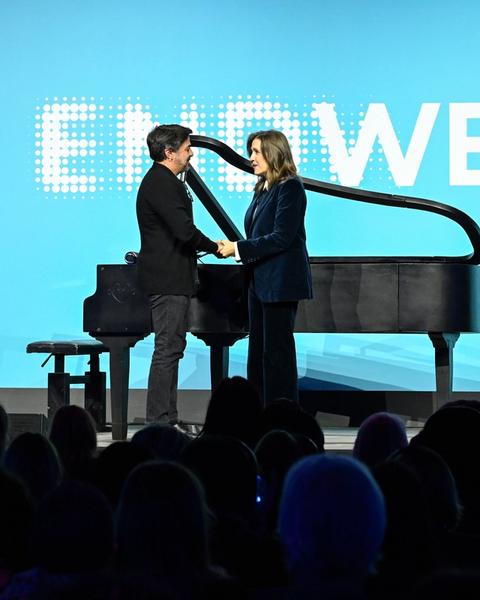
Amanda Kloots, Co-host of CBS’s “The Talk” shares with Yvette Nicole Brown about the devastating loss of her husband, Nick Cordero, and raising their son as she grapples with enduring grief.


November 16, 2023
Transcript
Yvette Nicole Brown: First of all, thank you so much for joining us. This is a wonderful opportunity to chat about something I know is important to me and to you. We’re both working to raise awareness about the things that people in our culture just don’t talk about.
For me, as I said earlier, it’s Alzheimer’s disease and, more recently, grief. This is my story: I lost my mom in 2021. I had just gone to Ireland to shoot Disney’s Disenchanted. It was the role of a lifetime. My mother told me, “You’ve got to go. You’ve got to do it.” I said, “Mom, I’m taking care of Daddy. What am I going to do with Daddy?” She said, “I’m going to move into your house. I’m going to take care of your father. You’re going to be fine.”
It was a three-month shoot. I was there a month, and she was diagnosed with leukemia. They put her in the hospital, and it was during the COVID shutdown, so there was a two-week quarantine one way and a two-week quarantine the other way. I would have missed a month of shooting if I came home. My mother was positive she was going to be fine. She said, “Don’t worry about it. You stay. You went there for a purpose.” Eight days in, she took a turn for the worse. She asked to go into hospice, and 12 hours later, she was gone.
My brother is a rock star. He held the phone for 12 hours so I could hold vigil with him, and the three of us were with her as she went on to glory. That’s my story.
I know that, seemingly from the moment you heard about Nick’s illness, it was important for you to share the experience of his illness and everything that was happening. What was it within you that made you so open during such a personal and difficult time?
Amanda Kloots: It started because, if we take ourselves back to March 2020, we were all in our homes, basically glued to the news and scared to go anywhere or do anything. At the time, I was home alone with Nick and my son, Elvis, who was 10 months old. Nick was sleeping all day, but he was 41 years old and perfectly healthy. Sleeping was not one of the listed COVID symptoms that you were supposed to be worried about, so nothing made sense. He didn’t have a fever. He didn’t lose his sense of taste or smell. He was just tired.
When we finally took him to the emergency room and they said he was going to need oxygen and they thought it was COVID, I immediately felt that I had to let somebody know. The only people I could tell were on Instagram. That was the outlet we had. At the time, I had 50,000 followers from my fitness business, which I thought was a huge amount. I started talking about my situation: “If anyone else is at home sleeping on the couch, maybe you should get a test or get checked.” That’s how it started.
I continued because, as we learned here today, and as I think we learn when we grieve, there is nothing like having a community behind you when you are going through something. At the time, I didn’t know how important it was to have people behind you every day. My 50,000 followers started to turn into 100,000, then 200,000. By the time Nick died, I had 30,000 people joining me on Instagram Live to sing every single day. Imagine that support. It changed me forever. I’ll never forget it.
Yvette: I was one of those people who popped in. You’ve spoken about how you’re a positive person by nature, which is apparent in everything about you. I wonder if the need to be positive all the time leads people to shut down and not share when things are difficult. Why do you think that is? How do we work through it? We want to show our best selves, but at the same time, we have to be free to show what’s real.
Amanda: I think you can only be positive if you experience the lows. You have to experience the lows to experience the highs. If you’re trying to maneuver your way around them, it comes off as fake or phony. Nobody wants to watch or follow a phony, positive person. You have to show those differences.
I think that’s also important in grief. You have to show the lows and the highs. I’ve experienced some beautiful moments in grief and, of course, horrible moments in grief. Trying to stay positive is the through line, the center line I’ve always tried to find.
Yvette: I’m really interested in the dual role you play as a public person and an advocate. I also feel like you go home and have a normal life with your son. How do you bridge those two worlds of being this forward-facing person everybody knows and then shutting that off and just being Mom when you get home?
Amanda: It’s hard. I’m on a television show that is live every day except Friday. That’s secret information: we tape Thursday’s and Friday’s shows on Thursday. My son is four years old now, and he is trying to understand what happened to his dad and that he doesn’t have a dad.
Yvette: It’s okay. We’ve got you.
Amanda: For some reason, he always brings it up on the way to preschool. I drop him off, and then I have to go right to work. It is so hard some days. Some days, you shut down and don’t want to talk about it or enter your world, but then you’re in a horrible mood. My energy is usually so high that when it’s low, my hair and makeup team doesn’t know how to deal with me. How many times can I say, “I’m just having a bad day,” or, “Another thing happened?” But I’ve gotten really good at saying it, especially to my co-hosts.
The other day, I had to say, “Listen, Elvis had a day on the playground where a little girl was asking, ‘Why don’t you have a dad? Where’s your dad? What does it mean that he died?’” Poor little Elvis apparently shut down, went quiet, walked away and started playing by himself. As a mom, I heard this and thought, “Who’s the girl?”
Yvette: I have pockets. This dress has pockets, and I brought tissues.
Amanda: Love a dress with pockets.
I had to get through two live shows that day. It was a Thursday. Then I went home, cried myself to sleep, screamed at the ceiling to Nick, hugged my stuffed animal that’s made out of Nick’s robe, and went to bed. That’s the life of being on camera.
Yvette: The thing that gets me is that, as I said, I was shooting Disenchanted at the time. My mom passed on a Saturday. I had Sunday, knowing I had to get it together. What are you going to do? I knew she wanted me to finish this movie. She sent me there.
I was on set Monday, and my first thought was, “Do I tell them? Maybe I just don’t tell them. Maybe I ride out these last two months without telling anybody, and then I won’t have to deal with it.” But in moments like that, you don’t know what you don’t know. You don’t know when you’re going to cry. I thought, “My poor makeup people. If I combust randomly throughout the day, they’re going to wonder what’s up.” So I had to tell them.
The beautiful thing about telling them, as is probably the case with your team, was that this group of Irish people I had known for only about 28 days wrapped me up, enveloped me and made sure I was okay. All I had to do was make a gesture, and everything would stop. They would let me go cry in the back, somebody would help me get myself together, and I would come back out. It sounds like that’s exactly what you have at The Talk.
The thing I’ve learned, and those of you who have grieved know this, is that grief is not a straight line.
Amanda: No, it’s not.
Yvette: It’s not, “I’m getting better every day.” I’ll be great today and a basket case tomorrow. You have to find the thing that gets you into the flow of something other than the pain. For me, it’s LEGO. If I build LEGO, my brain shuts off. Seventeen hours later, I have a beautiful creation. Maybe it’s crocheting, coloring or fitness.
Amanda: There you go. Fitness.
Yvette: I wish I had that. I don’t have that. Never had the desire. Not even a little bit.
Speaking of your baby, how do you approach conversations about loss and memory? You want him to remember his dad. How do you deal with that?
Amanda: From day one, I never… Oh my gosh. I’ll quickly tell this little story because it’s so beautiful. Nick passed away early in the morning. I came home, and my girlfriend had been watching Elvis. I walked into the house, gave her a big hug, took Elvis into the room where I was sleeping at the time, laid in bed and said, “It’s you and me, little man.” This little guy was one year old. He hugged me, fell asleep and passed out with me for three hours. I swear it was because he knew. I feel like he knew there was a shift, and he knew I needed cuddles. It was beautiful. There has always been something about us that understands it’s just me and him.
I’ve never stopped talking about Nick. I’ve never let him stop being a part of our day or our life. Lately, as I said, I’ve had to start telling Elvis why he doesn’t have a dad on Earth, but that he has a daddy in heaven who is around him all the time and whom he can talk to all the time. I’m sure that conversation will grow and deepen over time. That will be another layer of grief I haven’t had to deal with yet. I’m starting to deal with it, but it’s another layer of the onion.
Yvette: Let’s talk about self-care.
Amanda: What’s that?
Yvette: Therapists tell us that we need to be in a support group and ask for help. How do we also learn to shut the door and say, “This is great, but sometimes I just need time by myself”? How do you find that time to figure out how to make yourself feel better?
Amanda: This happened to me very early on after losing Nick. I had a good friend who was very much a part of the Cordero team we had, and he was dying to come over. Because I’m a people pleaser, I finally said, “Okay, okay. Come over,” knowing I did not want anyone in my house.
He came over, and we had dinner. I finally got the courage to say, “Trevor, I’m so sorry, but I need you to leave. I need to be alone right now. I love you. It has nothing to do with you. It’s just me, and I need to be alone.” He got up and walked out. I felt awful because he was such a good friend and had stood by my side through the whole journey.
About five minutes later, he texted me: “That’s such a great mark of our friendship. Thank you for telling me to get the hell out of your house.” It gave me room to breathe and realize that it’s okay to set boundaries. When we are grieving, especially at first, our emotions are all over the place. I remember feeling like an astronaut in space. I didn’t know what I was doing or saying. It was really nice to have a good friend who, when I felt awful about kicking him out, said, “Thank you. Thank you for being honest with me and kicking me out of your house.”
Yvette: I’ve also found that there are certain losses, such as a parent, a child or a husband, that no one else understands until it happens to them. When my mom passed, I called all my friends whose moms had passed before and apologized. I said, “Until this moment, I had no idea.” “It’s going to be better tomorrow,” and, “At least she’s in a better place.” That’s nice. It helps not at all. I know that now.
This is the other thing about the theme of today: Share your grief story. Share your death story. People will never know until it’s their turn, but at least they can understand.
Amanda: I’ll never say to somebody who has lost someone, “Let me know what you need.”
I’m not going to let you know anything. I don’t know what I need. The last thing I’m going to do is say, “Yvette, you know what I need right now? I need you to come over and do my laundry but not talk to me. Just do my laundry.” Why would you ever say that? Just come over and do my laundry. Don’t make me ask you to come over. I will never ask somebody what they need.
Yvette: That’s brilliant. To your point about telling Elvis to keep talking to his dad, Wendell Pierce, the amazing actor, called me when my mom passed. He had lost his mom. He said, “I want to say one thing to you: Continue the conversation.” I said, “What does that mean?” He said, “Whatever you would say to your mother before, keep saying it. Keep asking her questions.”
I’ll be in the kitchen going, “When you made this goulash, did you put two cans of green beans in with the corn?” I swear, Fran will be like, “You know it’s two cans of green beans. What are you doing?” I can hear her saying it back to me. It’s important to continue. It doesn’t end.
Amanda: The love doesn’t end.
Yvette: There’s one other thing I want to share about the grief journey: The grief is equal to the love. There gets to be a point in your grief journey, for me anyway, when I think of her and I’m not sad. I’m laughing because I think, “God, I had a great mom. For me to hurt this badly, she had to be amazing, because I am torn up right now.” It makes you realize what a gift it is that we had them. It’s never long enough, but we had them.
You’ve talked about keeping Nick’s memory alive. What are some of the ways you’ve found effective in honoring his legacy? Is that part of why you wrote your book?
Amanda: I wrote Live Your Life because somebody told me to. I didn’t know what I was doing when this was happening. It was the first time I had anybody I loved in the hospital, let alone in an ICU, let alone in a coma. I was flying by the seat of my pants.
In retrospect, it was the greatest gift in the world that somebody offered me a book deal and made me write down that story. It’s so detailed. I think a lot of people here will agree that when you go through something like this, you think, “Oh my gosh, I could start a whole hospital wing at Cedars-Sinai. I could do all the medical research. I could be a doctor.” You think you have it all in your head. That book is there for Elvis now. He will have the day-to-day account of what happened, and thank God it’s there.
I would say, to your point, never stop talking about your person. Elvis lost his dad at one. He doesn’t really have memories of his father. It’s up to me. When I take his socks off, I make this sound that Nick used to make. I go, “Boop,” and then ask, “Who used to do that?” He says, “Dada.” He doesn’t remember that. He knows because I told him. Maybe one day he’ll do that with his son or daughter. You have to keep saying their name.
I talk to Nick, like you talk to your mom, all the time, especially in the car. Does anyone else talk to their people in the car? I have full-on conversations. I hold his hand in my imagination. I sit there because I feel his presence. I’m driving and talking to him, telling him about Elvis.
We play his music all the time. I’m very lucky that Nick was an actor and a singer. We have so much video of him on Broadway and recordings of his music. Another thing I would say is: Take the pictures. Take the videos. I’m very lucky to have so many to show Elvis. If Nick had been an accountant, we wouldn’t have all this fresh material.
Yvette: It’s true. My dad was an insurance salesman for 65 years. He doesn’t have videos of him at work, talking and walking.
Amanda: I have video of Nick in rehearsals, walking, singing and goofing around. They’re things I can show Elvis one day. It’s magical.
Yvette: It’s funny that you mention that. Today has been about the inevitability of it. When I did some press about this day, a reporter asked me, “Why do you think people don’t talk about death?” It’s because we’re afraid. We’re afraid of what it’s going to do to us. We’re afraid of how it might feel if we can feel it.
My thought is: It’s inevitable. We’re all going to get out of here. It is the one thing that every single person on this planet is going to do. While you still have your people, I don’t care how old they are, get your video out and say, “Tell me about when you fell in love with Daddy,” and record it. If they don’t like the camera on them, put it somewhere they can’t see it and ask, “What was it like falling in love with Daddy?” Get the video. Those of us who live beyond want to remember them. Get it while you can.
We’ve talked a lot about what you’re doing for other people and the culture at large. What are some things people have done for you, online and in person, that you found comforting or helpful?
Amanda: One that really comes to mind is when I get a DM from somebody I don’t know, a follower, and they say they saw something I said and it really helped them. It’s a compliment and a help to me. Even in the public world, I get scared to keep talking about it some days. Some days I’m completely fine. Other days, I think, “If I post another thing, are people going to think, ‘Oh, this poor girl. Get over it already’?” You can get in your own head.
When you get that support, when someone says, “Thank you so much for speaking about this, saying this or sharing this little anecdote or sentiment,” it gives you the courage to keep talking about it. In our world, we have to keep talking about the people we’ve lost and the pain that still happens to us daily. That’s really helpful.
Rabbi Steve Leder gave me the best advice: Be your true, authentic self with people who have lost somebody. Show up. If you’re a baker, bake. If you’re a comedian, tell jokes. Don’t change who you are. You’re not trying to win the award for best dramatic performance in a grieving series. Come over and be the friend you normally are to that person. Those people really helped me.
Yvette: I love that. This is our last question. What is something everyone here could do from today on that you think would most change our culture around grief?
Amanda: Grief is a healing journey, and it’s a journey that doesn’t end. Our life here on Earth goes on. We’ve lost our people, but we go on. It never ends because we keep living life. With my son, every time he does something or I have to make a decision, I don’t have Nick to discuss it with. That hits you. Even dropping him off at preschool and seeing another dad dropping off his child guts you.
Our healing journey never stops. I think that is important to remember. You have to continually work on your healing. I am constantly doing wild and crazy healing things, as well as what you would consider very conservative or normal things, because I’m always trying to heal. I know it doesn’t end. We don’t get a trophy after a year that says, “You’ve completed it. You’re done. You’re healed from this grief.” It doesn’t end like that. It never ends.
Even if I find another person in my life one day, which I hope I do, that will be a whole other thing I’ll have to work through. I would love people to take away the knowledge that we have to continue helping people heal.
Yvette: My version of that, since we have a little more time, is that it’s important to talk about grief and death. In the entertainment industry in particular, if you are a writer, producer, comedian or whatever, talk about it. It’s horrible. We’re scared of it. But it’s inevitable. It’s coming for us all, and that should actually be the thing that gives you peace, because you can’t escape it. Why not lean into it, even if you’re leaning into the horror of it coming? This thing is going to happen to all of us. We don’t know how or when. We get to live these great lives until it’s our turn. Let’s make great decisions, talk to each other and share what we want so we’re prepared.
I have an aunt right now who is facing end-of-life decisions. I saw her in Cleveland before I came home. I thought the greatest gift I can give her is what we gave our mom. When our mom said she was ready to go into hospice, my brother and I knew that was what she wanted. She had told us our whole lives, “Do not resuscitate me. If I’m not going to have a quality of life, let me go into hospice.” As soon as she said she had had enough, my brother and I said, “She’s going into hospice now. Take the tubes out. Let’s go.” That was the greatest gift we could give her, and she gave that gift to us. We didn’t have to ask, “What would Mama want?”
We knew she wanted to be cremated. She didn’t want a funeral. The last thing my mother said was, “Don’t have a funeral, because anybody who should have said something to me about how nice I was should have done it while I was here. I don’t want to give them a chance to come and put on a show.” So Mama Fran was cremated. There was no program, nothing. That’s the way she wanted it. Knowing what you want and sharing what you want helps your people.
Amanda, you are a gift. I adore you. Thank you so much, honey, for taking this time.
RELATED