Don't Be Afraid to Talk About Your Grief
All of us will face grief and loss. And when we do, Modern Loss' Rebecca Soffer urges us to talk about it openly and honestly, whether online or in real life (IRL). By sharing our stories and feelings in a way that is raw and vulnerable - and listening to them with an open mind - we can learn to give the right support to those who need it, get it from others, and build meaningful community around a topic that should no longer be stigmatized.

December 6, 2018
Transcript
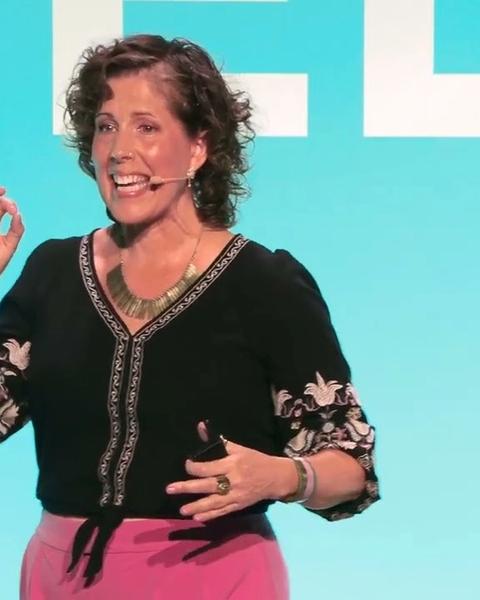
Oh, hi, everyone. I am here to talk to this community, to everybody sitting here in this room, anybody watching online, about the immense value in sharing our personal stories in a way that is honest and raw and vulnerable as a means to build bridges between us.
Earlier this year, I embarked on quite an adventure in the form of a national tour for my new book, Modern Loss: Candid Conversation About Grief. Beginners Welcome. Now, this was a really exciting time for me and my co-author, Gabby Birkner. It was really exciting to, like, I don’t know, have a book come out, be with a publisher, see that people had heard of it. It was pretty exciting to fantasize about getting four, nay, five consecutive hours of sleep away from my baby back home in New York City. I didn’t, but that’s another story.
But mostly it was exciting because I finally was going to put my theory to the test that our online readers were going to get the chance to meet other kindred spirits and form a meaningful personal connection at our events. I mean, Modern Loss was about to go full-on IRL.
I’d just spent the last several years staring at a lot of screens, needing increasingly stronger glasses, and looking at likes and comments and prayer hands and, like, whatever this is. I don’t know, like, praise be. And it was obvious that we were helping people by what we were doing at Modern Loss, but what wasn’t exactly clear was how, and most important, if they were helping each other.
I went into the book tour assuming that the live events were going to be more meaningful than anything that we had done beforehand. Well, turns out I had a lot to learn about community and about the bonds that grief creates by its democratic nature alone.
In the end, what I learned is that a combination of in-person and virtual communities gives us the best chance to reach the broadest range of people and help them deal with the widest range of experiences. But it only works if we’re willing to open ourselves up and share our stories with candor, and listen to other stories with the same level of honesty.
But first, let me tell you why I’m involved in any of this stuff in the first place.
I’m highly aware that I’m standing in a room full of amazing professionals, and many of you have chosen to work in the death and dying and grief field, and for that I thank you deeply. Give yourselves a round of applause.
Okay, stop now. Stop, because I’m on a timer.
I feel, now that it’s like three o’clock in the afternoon, comfortable enough with you to share that I would have actively not chosen to do something like this with my life. I was on track to produce political satire for a living. Wait, sorry, “a living.” You guys seen a comedy paycheck? It’s like a living, not even healthcare.
But we all know that the universe doesn’t give a flying fig about what your specific plans in life are. It certainly didn’t give a flying fig about mine, which was getting to build a life that heavily featured my parents, Shelby and Ray, who I was really close with.
On Labor Day in 2006, I was winding down a pretty great camping trip with my parents in upstate New York, in the Adirondacks. It was amazing. The day started with me jumping into the middle of Lake George, taking a swim with my mom, laughing and talking about plans for the fall. And it ended with me slumped onto a hospital floor in the middle of Jersey and with my mom in the morgue.
They dropped me off a few hours beforehand at my apartment in New York City and continued on to my hometown of Philadelphia. Shortly after, they swerved to miss something in the road on the New Jersey Turnpike, and the car flipped several times over, and my mom was killed immediately. At least, that’s what I tell myself.
Now, I have a lot of amazing people in my life, but my mom, I’m an only child, she was my person. I mean, look at her. That was us in Lake George when I was a little bit younger than that.
Her life ended that day, and for a long time, I honestly had no clue how mine was going to continue in a way that was meaningful or happy. And I liked being happy, and I liked being full of meaning.
Fast-forward to November 2013. Gabby and I had just launched our website, Modern Loss, and we had done it while enormously, almost insultingly pregnant. Talk about leaning in. We’re crazy.
By that point, I felt pretty well-versed in the cornucopia of absurd and embarrassing and gut-wrenching experiences that grief just serves up on a daily basis, right? Because by that point, I hadn’t just lost my mom.
In 2010, right before the holidays, December 17th, coming up on the anniversary, my dad took a cruise to the Caribbean. Late one night, he had a heart attack, and he came back dead. And I was 34.
Gabby and I had spent years sifting through different communities online, looking for support, looking for connection, and we felt like we could just do better.
What we found were community websites that were driven with kind of, like, a pop psychology of grief anchored in platitudes best served for a throw pillow project. You know, “They’re in a better place.” “It takes a year.” Things involving doors closing and windows opening and Oprah. I don’t know. Things that just didn’t really resonate with me, which is why I can’t remember them.
And we saw a white space to serve a wider community of people who were looking to feel assured that they weren’t alone, even when they felt alone.
A website that could publish high-quality personal essays that were narrowly focused around one aspect of the very long arc of the grief experience, but anchored with a backbone of practical resources: legal, financial, therapeutic, advice columns, gift guides that included suggestions very specifically not involving Edible Arrangements. Sorry. They hate me by now because I’m, like, always...
Anyway. Sorry. Yay.
We just wanted people to be able to stand in their own story and feel drawn out of their isolation and inspired by someone else’s. And especially a place with lots of room for humor and bawdiness and realness amongst the ugly cries. And we know there are a lot of them.
Our readership took off immediately, and I watched as the shares and the retweets ticked upward and upward and upward. I learned what a bounce rate was. It’s, like, much less cool than I thought it was.
But I kept wondering, while I was looking at all these numbers: Is all of this seemingly inauthentic engagement actually real? Would it actually translate to something meaningful when we show up at all these book events? Are we going to hear crickets?
Well, the short answer: yeah.
Our book launch in Brooklyn was standing room only. There were 230 people. We broke the attendance record for PowerHouse Arena. Even Chelsea Clinton showed up, which is cray.
And as we traveled from coast to coast on this big national tour, it became pretty clear that the accents and even the political slogans greatly varied from place to place, but the intense need for community around grief was the same everywhere.
In fact, we were providing a meaningful opportunity for people to gather and connect over their grief across the long arc of it at these events.
In Atlanta, I met a group of women, and they were amazing. They looked like they’d been best friends for years. When I asked them about it, they said, “Well, actually, we all live on the same block, but we only became really close when one of us saw one of the others reading the Modern Loss book on the porch and asked to borrow it because I had lost somebody. Then I lent it to the next neighbor because it turns out she had suffered a miscarriage,” et cetera, et cetera.
“For the first time, we actually feel like neighbors, as opposed to people who live on the same block.”
That’s them. They’re amazing.
In Austin, we did a great live storytelling event, and two women showed up who had experienced stillbirth. They’d never met each other before, and they left together.
And at Kripalu, I was leading a workshop on owning your narrative. Kripalu is a retreat center in western Massachusetts. I met a really awesome woman in her 20s who had, insultingly, lost both of her parents within just over a year to the same type of cancer. I found out that she was actually inspired in part by that retreat to start her own personal project around loss. Interestingly, an online one.
Speaking of online, around the same time that I was schlepping all around the country, because it really felt, like, schleppy, I was very heavily administering our closed online Facebook group. Sorry, it’s 3 p.m. I’m tired.
I had started that a few months before the book came out, and at the beginning I had to seed a lot of conversations. The group was small, and people were kind of shy. But then people started inviting everybody, by the fives and by the tens, and all of a sudden the exchanges flowed.
And I paid very close attention.
People were kind to each other. They offered really great advice on everything from the excruciating to the absurd. They were inspiring. They shared really freaking funny stories about funerals gone wrong, or all the other things you’re not supposed to laugh about in casual conversation.
And if you want to know my favorite, I’ll tell you. It’s the time that a woman’s toddler belted out “Happy Birthday” just as her grandfather’s coffin started getting lowered into the ground.
Clearly, that’s awesome, and she should definitely work in comedy.
But yeah, these people were connecting with each other, and it was incredible. Whenever someone joined the group, they were always met with a very warm welcome. They were so glad you were here.
Now look, you can cite any study you like about how social media is going to totally decimate your mental health, and I can point you to a couple choice Twitter feeds that are accomplishing that for some of us. But in the conversation about grief, that’s just not what my experience was in our online group.
I saw a friendship bloom between a Texan and a Chicagoan who had met because of our Father’s Day gift swap, during which I crazily matched 150 perfect strangers from all over the country who just needed an outlet for the day.
I saw Corinne from Baltimore basically nearly single-handedly keep a couple dozen people sane who were hanging on as they braced themselves for their first motherless Mother’s Day or childless Mother’s Day.
And I watched a bunch of people consider who they might reach out to after Sia told us all about the CEO at her company, the one who just barreled his way in and made no friends in the process. But then his wife died of a brain tumor, and her dad had been murdered several months beforehand, and she left him the Modern Loss book on his desk.
The next morning, he left her a note on hers that made her bawl. And she told all of us, “You know, this dude was never one of us. Now he’s one of my people.”
And so, you know, the joke was kind of on me.
Here I was assuming that an online community is only as legitimate as the in-person one that it spurs on. But in fact, I was being proven wrong over and over again by the very community that had grown up around me.
A lot of us do best with in-person interactions, right? Especially when it comes to grief. We deal well when we can read someone’s energy in the room or read their expressions. We can hug them or share an enormous plate of fries while commiserating, or, for our Canadian friends, poutine.
For others, we work best online, especially when the topic is grief, which is something that so many of us go to such great lengths to avoid facing head-on.
Online, such as the group that we run at Modern Loss, we provide a refreshing anonymity away from family and friends who someone might not want to burden, and also a feeling of being included in the conversation even if you don’t feel like speaking up.
So what I learned from this is that Modern Loss has actually provided a platform where both types of people can engage. And some of us need both, and I’m one of them.
More important, it became very clear to me that the more that we put ourselves out there to share our stories with honesty, the more we will reap the rewards of doing so.
Modern Loss was built on the tenet that storytelling is a changemaker. And I’m not the only person who gets that. Neither is Gabby.
Barack Obama gets it. He just talked about how powerful the exercise of storytelling is because, after you’ve done so, you find you have a different relationship with that person than you did beforehand. A sense of something shared. A community that’s just been waiting to be unearthed.
Congressmen Will Hurd and Beto O’Rourke get it. I don’t know if you guys remember, last winter there was this huge snowstorm that forced them to drive from San Antonio to D.C. Maybe you’re not, like, as into politics as I am, but I actively remember this.
They discovered all these commonalities along the way, so they ended up livestreaming this bipartisan road trip, and it was really awesome.
I don’t know how well they saw eye to eye beforehand, and I have no idea if they see eye to eye now, but I’d wager that belting out “Ring of Fire” across half a dozen states and then scarfing down doughnuts in front of Graceland is going to engender a whole lot of goodwill between two people who are on opposite sides of the aisle.
Hell, even the Queer Eye guys get it. We start every episode looking at one of the subjects kind of through the stereotype that they present, and we end it seeing them as a human being.
You guys, I don’t know about you, but I feel like we are so rapidly losing any sense of commonality in this country, and we so desperately need to do the opposite and pull each other in.
It is an imperative right now for us to figure out a way to build bridges, and loss is what cuts across all the noise.
When you are dealing with grief, you have no choice but to find where your authentic connections are. That’s a good thing for community and a really good thing for the world at large.
In grief, all of our differences are leveled. We’re all going to experience loss. And I just feel like if you hear someone’s story of deep grief, you’re probably going to be less inclined to, like, go to war with them. Maybe not let them into the country. I don’t know if that makes sense. Or just maybe not judge them harshly. I don’t know. Just a thought.
Grief is the great leveler. We’re all going to face loss.
And what I didn’t understand that night when I struggled to absorb the fact that my mom was dead was that grief is not a black-and-white thing. Loss is not a black-and-white thing.
It seemed it that night, but it actually provides you with so much color and so many different shades of lightness and dark, often when you least expect it to.
And so the next time you find yourself in a situation where grief is the topic at hand, whether it’s a chosen one or one that is just unavoidable, whether you’re a physician who’s done this thing 100 times over or, like, a marketing manager who’s trying to help out a buddy who’s going through a tough time, whether you’re in an online forum or you’re at a cocktail party, just remember that if you can allow yourself to open up and share your story with rawness and honesty, and listen to that person’s with the same mindset, you might create your own ripple effect that might not only alter that person’s day, but might alter their entire grief trajectory.
One of the last things my mom said to me the night that she died was, “Take care of my girl.”
It was kind of her catchphrase for me because she knew I could be marvelously, and that’s code for annoyingly, self-deprecating.
And I miss her so much. I would do anything to get her back here so that she could meet her grandchildren, and she could meet my husband, and she could see the absolute miracle that is my hair getting increasingly blonder naturally with each passing year.
Thank you.
But she’s dead. And I do what I can do because of it. And part of that is fostering this community that has given me back so much in return.
I might have lost my person that night that she died, but I found my people because of it.
Thank you.
RELATED