What Improv Can Teach Clinicians
What makes a good scene partner? Palliative care clinicians and improvisers swap tools for listening, staying curious, sharing the lead, and receiving even the hardest gifts.


October 29, 2026
Two palliative care clinicians and three improvisers on scene partners, curiosity, and what to do with the gift you're handed, even when it's a box of ants.
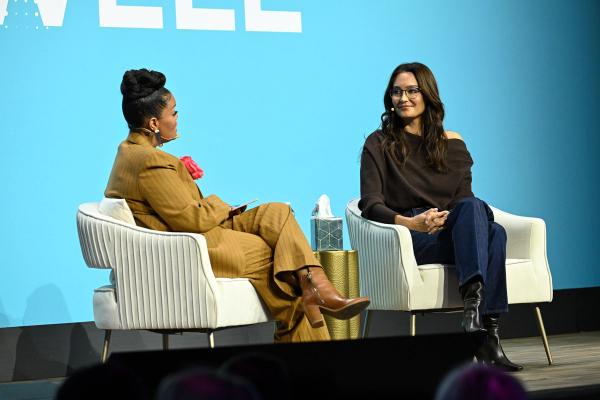
What does an improviser have in common with a clinician sitting with a family facing serious illness? For End Well's Tracy Wheeler, the connection surfaced while listening to clinicians describe their work. The ones patients seemed to trust most could read the room, stay present, and respond to what was actually happening in front of them.
Ahead of the "Read the Room" improv workshop at End Well, Tracy brought together pediatric palliative care clinical social worker Rachel Rusch and physician Tanya Arora, who teach what they call palliative improv, with Patrick McDonald, Nikki McKenzie, and Katie Marovitch, improvisers trained in the Upright Citizens Brigade (UCB) tradition. Before leading their workshop, Patrick, Nikki, and Katie wanted to learn from Rachel and Tanya. What followed was a crash course in both directions.
This conversation has been condensed, edited, and reordered for length and clarity.
Where improv and palliative care meet
Tracy Wheeler: Over the years, listening to some really amazing clinicians talk about their work, it began to dawn on me that what they were talking about was improv. The people most loved and trusted by their patients are able to read the room, be in the room, and be present. They're in a fluid, dynamic relationship with what's in front of them, clinically and personally.
Then I thought, well, maybe I'm crazy to make this link. So I Googled, found Rachel and Tanya's work, and reached out. And, indeed, improv and care is a thing! Which is why we asked Patrick and his colleagues to join us to teach a workshop at End Well this year.
The conversation that transpired was magic.
Patrick McDonald: How did you get into this? I'd love to know the whole story.
Rachel Rusch: I'm a pediatric palliative medicine clinical social worker. I've been practicing pediatric palliative care for about 10 years. Though before that, I have a BFA in acting from Boston University. My background is in the theater.
I kept that a little hidden when I started this path, because I wanted to be taken very seriously as a very serious social worker. Colleagues like Tanya helped me see that my theater background was some of my best training for this work. Improv, and my background in clowning, turned out to be much more intertwined with holding space, bearing witness, finding joy, trusting oneself, and building partnership than I ever imagined.
Tanya Arora: I'm a physician. I started my career working with children with medical complexity and in global health, then came to palliative care. The more I grew in my career, the more I was asked to speak publicly. I have no training in being onstage. The idea of speaking in front of peopleterrifies me. So to help me practice, and maybe because I live in Hollywood, I decided to try an improv class! I found myself learning so much.I'd go to class Wednesday nights, come back Thursday morning, and say, "Rachel, that thing we learned in improv last night? That's the same thing we're doing in patient rooms." And Rachel was like, "Yes!"There is an established practice and community of folks doing medical improv, started and grown by Katie Watson and Belinda Fu. They have taught and trained so many of us to use lessons learned from improv theatre to strengthen communication skills in healthcare. Rachel and I found that improv could be used even more specifically to teach the complex communication skills needed in palliative care - specifically deep listening, compassionate presence, and partnering within uncertainty.
What makes a good scene partner
Patrick: Coming into this, the big thing for us was never to assume what palliative care workers need, because we can't speak to that. So we asked: What skills can we speak to? We landed on what makes a good scene partner versus a bad one. And even if you're a good scene partner, how do you partner with someone who isn't listening, or isn't picking up on the cues?
We have a lot of improv jams out here, where seasoned improvisers play with brand-new people who don't have the tools yet. Sometimes the funniest thing you can see is a seasoned improviser working well with somebody who doesn't really know what they're doing. That's where the magic happens.
Tanya: In health care training, I don't think we get taught to be a good scene partner, whether you're a physician, a nurse, a doula, or a social worker. Yet so much of our work with patients depends on trusting each others’ expertise and building a scene together. There's so much pressure on healthcare workers, especially post-pandemic, to feel like we have to figure it all out on our own. But we cannot possibly figure out how to care for someone else on our own, care in health care requires partnership with colleagues and with patients. We know in palliative care that we have to partner with people to hear their expertise, their goals of care, how they want to live and how they want to die. And yet the systems we work within, the training we receive, and the demands on our time are not structured to support caring within partnership. Rachel and I say this in our sessions: Please bring 100% of yourself to entirely 50% of this interaction, thereby leaving space for your partner to bring 100% of themselves..
Rachel: In healthcare, we're taught impactful mnemonics for assistance in delivering serious news, or we role-play how to talk about death and dying or a change in prognosis. But how do we really inhabit those spaces as humans? How do we think about it relationally - with a patient, a parent, a colleague, a surgeon, or another partner in care?
People sometimes come to our courses thinking, "Improv is so scary. I have to be funny. I have to perform." Part of the work is breaking that down. Andit's also: How do I connect to my enoughness as a clinician? How do I connect to myself as the foundation for whatever lies ahead?
Borrowing from the improv stage
Patrick: That's so striking. At UCB we talk about flash memory. If someone says, "I'm going to the doughnut shop," I flash to a memory of a doughnut shop with a weird sign, and I use that specific detail. That's how your improv becomes specific, because it's coming from you, and there's only one you. I'd never thought about that from the other side, a physician in a room thinking about their enoughness and what they can bring.
Another one is "peas in a pod." Think of Garth and Kat on SNL, singing together at the same time. When you're doing the exact same thing as the other person, it's nonverbally validating. Even picking up the language someone is speaking in. Not full code-switching, just tiny moments. It's a feeling of comfort you can bring to somebody, and it's satisfying when someone mirrors you.
Nikki McKenzie: Something Patrick talks about a lot, which I love, is being so curious about your scene partner. That's the easiest way into a great scene: being curious about who's there with you, and listening. It's hard to do.
Patrick: In UCB-style shows, we'll often ask someone in the audience to tell us something that happened to them today. If someone's story has something weird in it, you circle it and say, "This is what I find funny." That's how we pull a premise to start a scene. But if you replace the word funny with comforting, or interesting, or endearing, and then mirror that back to somebody later, they feel satisfied.
Tanya: Palliative folks will get that. We'll often say, "What I heard you say is," and then repeat what the person said.
Patrick: There's also "resting the game." In a scene, the game is the funny, unusual thing. So you don't hit it over the head, you rest the game by moving to another topic. Eventually the game is so present and so big, it always comes back. We imagine that's what the big, scary thing in the room is like.
Staying curious about what someone is feeling
Nikki: Do you teach through role-play and improv games? What are your favorite exercises?
Rachel: Our workshops are exercise-based. We also weave in narrative medicine, reflective reading and writing, and we debrief while the energy of an exercise is still in people's bodies. This proves helpful for connecting our cerebral inclinations as people in healthcare.. Sometimes the debriefs are as powerful as the games, or more, because people start to vulnerably connect the games to their work.
One of my favorites is about naming emotion. People stand in two lines, facing a partner. One person picks an emotion: happy, sad, angry, frustrated, grief, elation. Without any pressure to perform, they say the word "hello" imbued with that emotion. Their partner responds, "Hi, Tanya, you seem excited," or whatever they think it is that their partner is aiming to communicate. They get three tries. If the partner doesn't land on it, the group weighs in, and then the person shares their word.
The debrief is always rich. People say, "I thought I was showing sadness, and I kept hearing anger back." Or, "I thought I was showing happiness, and I kept getting calm." It's about curiosity, never self-critique.
For the person guessing, it raises the question: How often are we in rooms where we assume someone is feeling a certain way, and the internal bias we all hold leads us to one blanket idea of what they're experiencing? How can we center curiosity in our connection as clinicians?
A palliative team might be called into a room because "A parent is really angry and upset," and the team is even feeling threatened by theirpresence. And to name it explicitly, we might enter and see a father from a marginalized population who is grieving.. How do we think about curiosity in a systemic context, too? The exercise expands what it means to be curious in an emotional space and in partnership with those around us.
When your scene partner can't respond
Katie Marovitch: When my dad was in hospice, he couldn't talk very well. Nurses and doctors would ask him a question, and it would take him a good 60 or 90 seconds to respond. I think some of them thought he was more confused than he was, but it was actually very painful to talk. How are you a scene partner with someone who can't respond?
Rachel: That makes me think of our work in pediatrics, with very young children or people with severe neurologic impairment for whom communication is different from how we as typically developing adults might communicate.How do we continually ground ourselves in finding ways to honor our shared humanity? How do we intentionally create the holding space for those who may communicate differently? Improv holds so many lessons for clinicians within these questions.
At the root of this improv work is also people's reconnection to themselves and to what brought them to the work. I think that's urgently important in healthcare now, more than ever.
After a hard day
Nikki: My dad also died in hospice, and our palliative social worker was a saint. But there was so much burnout on the team caring for him. Do you talk about how you take care of yourselves?
Patrick: We likened it to a bad improv show. You walk off and go, "That was rough," and we just laugh about how bad we were. There's stress relief in owning failure. Obviously, the stakes are so different.
Rachel: For us, the equivalent might be a family meeting that felt difficult, - or supportingwith a colleague who is struggling because they feel a family is making the “wrong” decision. We often look to our improv workshops to foster community and rethink how we care for ourselves and one another.
Even within bringing 100% of yourself to 50% of the interaction -sometimes your 100% is 20% that day. Sometimes it's 75%. What 100% means is dynamic, and we need to pay attention to that within our teams, and as scene partners, too.
Listening without fixing
Tanya: We like to end with some sort of gift. With a boisterous group, I might end by counting to 20 together, then reflecting on how we all needed each other to get there. Sometimes you're the person who has to step back. Sometimes you have to step forward. If you didn't say anything, think about why. If you said most of the numbers, think about why.
Other times, we end with an exercise we call "This Is My Partner." People pair with someone they perhaps do not know well and spend two minutes telling a story about something that's been hard or frustrating, at work or outside it. For those two minutes, the listener says nothing, which is very hard for palliative care people. No follow-up questions, no compassionate reflection.. Then they switch roles and the listener becomes the speaker and the person who previously spoke now listens.
In the debrief, someone inevitably says, "I didn’t feel like I was being supportive. I didn’t say anything helpful." And their partner turns to them and says, "I felt so supported. You were so present with me."
Then, as a group, we ask people to introduce their partner by the positive value they heard in the story. We don't want the story itself, but we want to hear the underlying value in that story of frustration, noting that perhaps the speaker themselves hasn’t even yet been able to see through their frustration or anger to identify that there is a positive value that is motivating their strong feelings. For example, Rachel may tell me a story of tension between colleagues and I may introduce her as "This is my partner, Rachel, and she really values kindness."
Sometimes we need to help each other to see through the anger or frustration to the positive source underneath. When a parent is angry about delays in their child’s care, I can hear them saying how much they care and want the best for their child. I do, too. I can join you in that space.
Steamrollers, gifts, and sharing the lead
Patrick: One thing a good scene partner doesn't do is steamroll. I can speak to it: it's usually a guy in his 20s whose friends all say he's the funniest one in the friend group. . He comes into a scene and runs everything. I think that works both ways in healthcare. Patients have felt steamrolled by their physicians, and physicians have definitely felt steamrolled by their patients. Does that come up for you?
Rachel: Absolutely, between patients and medical teams, and between medical colleagues. We're often in big family meetings: parents with the ICU team, palliative care, oncology, nephrology, etc. For us, steamrolling might be about when certain voices aren't being honored or heard, most especially the patient and family.
In our workshops, we do a simple mirroring exercise. Two people face each other. Without words, one leads and the other follows. If you're leading, how are you caring for your partner and making sure they can follow? We all have differences in ability and physicality. If you're following, what do you notice about trusting someone else? Then they switch. If the connection is there, we ask them to pass the lead back and forth without words.
That gets at something we're rarely taught in healthcare: what leadership means in clinical care. Sometimes the patient must lead. Sometimes the parents must lead. Sometimes the ICU teammust lead. Sometimes our leadership must be shared in a dance back and forth together, all in one moment - this is often a role that palliative care centrally attunes to.
We also do a gift exercise. One person hands their partner an imaginary object of any size. The partner opens it: "Thank you so much for this box of diamond dust. I wasn't expecting that." The giver may have had something else in mind, but now they respond: "I got you diamond dust because you bring so much sparkle." Or, "I got you this box of ants because it felt like the best metaphor for how itchy and difficult the days can feel sometimes!”."
Sometimes an improviser knows Lorne Michaels is in the audience, andthey're trying so hard to show their best self that they lose the connection. How can I, as their scene partner, see even that as a gift? Steamrolling isn't helped by me steamrolling back, or by saying no. The question is how I build partnership from it without being sidelined: taking the gifts that are given, even when they're tricky and hard to receive.
Patrick: For us, this isn't about trying to fix or solve anything. It's: This is our expertise. These are the tools that help us in our field. Then we'll see what happens in people's brains as they walk away with them.