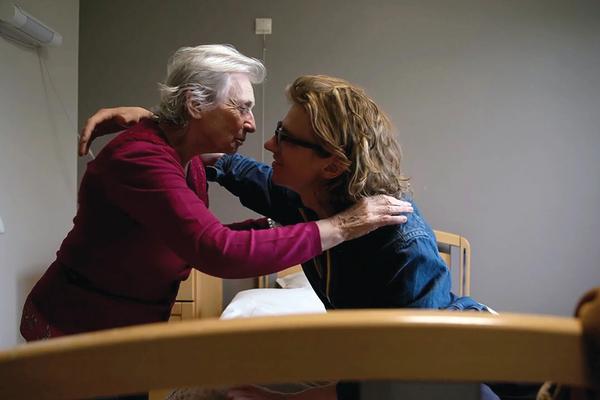
“Invite the Awful”
Tamatha Thomas-Haase on Living Fully While Dying


November 3, 2025
What does it mean to practice empathy when life feels unbearable?
In this Radical Bravery conversation, cancer patient and public health professional Tamatha Thomas-Haase speaks with End Well’s Tracy Wheeler and Molly Rosenfeld about the art of being present during life’s hardest moments.
Through her concept of the Bus Lane, Tamatha asks us to recognize that any of us could be changed by life in an instant. Empathy is how we meet one another when that happens.
She offers practical tools for clinicians, caregivers and loved ones, including mirroring, naming emotions without trying to fix them and learning to hold two truths at once.
This is a story about courage, inequity and the radical act of staying human, even when the systems around us fall short.
Tamatha brings a distinct and powerful voice to conversations about healthcare. As both a cancer patient and a public health professional, she understands the healthcare system from multiple perspectives and speaks openly about what is working and what needs to change.
Edited for clarity and length. Part of our Radical Bravery series.
The Power of Perspective
End Well: Tamatha, you often use a phrase that stays with people: the Bus Lane. What do you mean by it?
Tamatha: We’ve all heard someone say, “Well, I could get hit by a bus tomorrow.”
I invite people to picture themselves standing in the bus lane because any one of us, or someone we love, can be hit by life at any moment.
For me, that is my daily reality.
The point is to wake us up to how we want to live and care for one another now.
“We’re all standing in the Bus Lane. Empathy is how we meet each other there.”
End Well: When you’re invited to speak from the patient perspective, you’re careful to acknowledge the limits of your own experience.
Tamatha: My experience with breast cancer is a privileged one.
I had quick access to diagnostics and specialists, strong family support, flexible work and fewer financial pressures. I have doctors who advocate for me with insurance companies and access to medications that were tested in clinical trials involving women who look like me.
That is not true for many people, especially Black and Brown patients, people living in poverty and those managing mental health conditions.
When I offer guidance, I want it considered alongside realities beyond my own.
When Healthcare Falls Short
After moving to a new state, Tamatha transferred her metastatic breast cancer care to a new medical center and palliative care team.
“This isn’t a rural hospital,” she emphasizes. “This is a renowned cancer center.”
Her experience there, particularly with her first palliative care physician, demonstrates how even leading medical institutions can fall short when it comes to basic human connection.
Her initial visit focused on logistics and prescriptions rather than the empathy she needed most.
“I didn’t need information about constipation. I definitely didn’t want a Narcan prescription when my pain level was one out of ten. What I needed was empathy, someone who could see the juxtapositions I’m living with every day.”
The Art of Active Listening
Conversations about dying and end-of-life care are among the most difficult interactions in medicine. Yet physicians and medical students often report feeling unprepared for them.
Well-meaning clinicians may avoid difficult conversations because they have not been taught how to navigate them effectively.
End Well: Your upcoming talk centers on empathy in the clinical encounter. What does that look like?
Tamatha: An empathy-rooted visit improves how I live today and prepares me to die better when that time comes.
When my providers make space to understand the dualities I am holding at any given moment, they can offer care and help me make decisions grounded in something even more important than my pain chart or vital signs: my aliveness.
“An empathy-rooted visit improves my living now and prepares me to die better later.”
End Well: Many loved ones and clinicians freeze because they’re afraid of saying the wrong thing. You’ve suggested some simple handrails.
Tamatha: Try mirroring. It is Active Listening 101.
Reflect what you heard and the emotion that may lie beneath it before adding anything new.
“It sounds like having scans near the holidays feels especially hard.”
“It makes so much sense that you feel that way.”
“Is there more you want me to understand?”
Mirroring allows the other person to guide the conversation without making anyone wrong. It creates a beautiful runway for the conversation to deepen.
Understanding the Complexity of Serious Illness
Living with serious illness often involves emotions and experiences that appear contradictory from the outside but make complete sense to the person living them.
A patient may feel hopeful while remaining clear-eyed about mortality. They may want independence while also needing support. They may be living fully while preparing for death.
End Well: You also talk about living with juxtapositions, holding two truths at once.
Tamatha: I can be hopeful and clear-eyed about mortality data in the same breath.
I want clinicians to practice holding that with me.
As a grounding tool, I ask, “What would your patient’s T-shirt say today?”
When you cannot answer that question, or you are only guessing, begin your next visit by asking questions that will reveal it.
What fuels their aliveness? What drains it?
Your care plan should help bridge that gap.
Advocating Within a Broken System
End Well: Patients are often told to advocate for themselves, yet they risk being labeled “noncompliant” when they do.
Tamatha: It is a thin line.
Insurance approvals often depend on peer-to-peer reviews, which means patients need clinicians who are willing to fight for them.
We need to design systems and practices that do not punish the people who most need help.
Those of us who can take the risk of telling administrators and clinicians what failed us simply must do so.
End Well: You worked in public health for decades. How do we reconnect individual care with the health of the larger community?
Tamatha: We have to be honest. The public health system was never designed to optimize everyone’s well-being, and the COVID-19 pandemic exposed its racist foundations.
I am cautiously hopeful as people trained in public health enter private healthcare systems. They bring an approach rooted in community, public service and the social and political determinants of health.
We also need to tell the story of public health more effectively. The work is vast and often invisible until the moment it is desperately needed.
End Well: You’re entering another scan cycle around the holidays, an emotionally loaded time for anyone.
Tamatha: That is exactly why empathy matters.
It will not change the scan. It changes how I am held while I move through it.
That is what I want to model: simple, brave practices that make living fully more possible in the Bus Lane.
Try This
Mirroring in Three Steps
Name what you heard.
Validate it without trying to fix it.
Invite the next truth.
The T-Shirt Prompt
Ask:
“If today were a T-shirt, what would it say?”
Listen for the juxtaposition:
Hopeful and exhausted.
Ready to fight and ready to rest.
Document it. Revisit it. Allow it to guide care.
Every person deserves their own version of a good life and a good death.
Empathy is one way we help them get there.