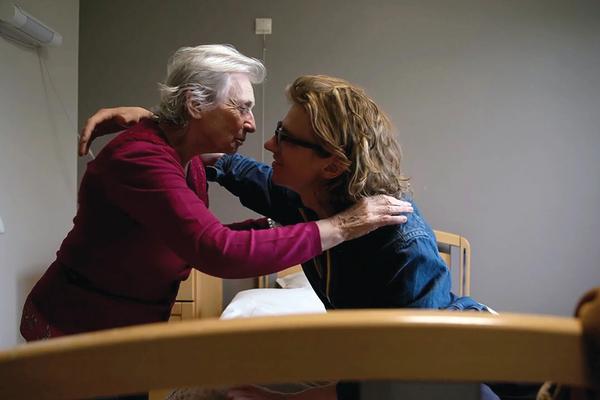
How Supportive Care Improves Quality of Life
Susan Hedlund on making whole-person support a standard part of care for patients and families facing serious illness.


October 28, 2025
Susan Hedlund, LCSW, has spent more than three decades at the heart of healthcare, walking alongside patients and families during some of the most vulnerable moments of their lives.
Today, as Director of the Supportive Care Initiative at the Sheri and Les Biller Family Foundation, she is working to make supportive care a routine part of serious illness so that no one has to face it without the resources and compassion they need.
Who Is Susan Hedlund?
Susan began her career as a hospital social worker, supporting patients in settings ranging from the emergency room to the intensive care unit.
Over time, she gravitated toward oncology because it allowed her to build ongoing relationships with patients and families.
“In those years, cancer patients stayed in the hospital a really long time,” she recalls. “I got to know them well. I really loved having those longer-term relationships.”
She went on to lead Patient and Family Services at the Knight Cancer Institute at Oregon Health & Science University, teach in the OHSU School of Medicine and serve as an associate professor at Portland State University’s Graduate School of Social Work.
She also shared her expertise through the University of Washington’s palliative care certificate program, helping train the next generation of clinicians.
Her work has received national recognition. Susan is a past president of the Association of Oncology Social Work, has served on the board of the American Psychosocial Oncology Society and received AOSW’s Leadership in Oncology Social Work Award in 2024.
What Is Supportive Care?
Susan defines supportive care as whole-person care. It addresses the emotional, psychological, social and practical needs of people living with serious illness alongside their medical treatment.
“Supportive care is the broader umbrella of things that are non-medical: patient and family counseling, nutritional support, mindfulness-based stress reduction, integrative medicine services, things patients and families can pick and choose depending on their situation to ease the burden of illness.”
That additional layer of support can help patients and families feel less alone, more informed and better equipped to live with illness.
Supporting Families and Caregivers
Susan is clear that supportive care must include family caregivers.
“We have to support our family caregivers up front, not wait until we’re discharging somebody and saying, ‘Good luck.’”
An estimated 63 million Americans provide unpaid care to a family member, contributing labor valued at more than $600 billion each year.
Without adequate training, financial support or workplace flexibility, caregivers often pay the price through their own health and financial stability.
“If we give them support, give them resources, we can reduce caregiver burden and may also reduce complicated grief,” Susan explains.
Without that support, families may carry unresolved questions and “what-ifs” that deepen their sorrow after a loss.
For more on the relationship between caregiving and grief, see our conversation with Deb Whitman and our research on Death on Television: Flipping the Script, which examines how culture shapes caregiving and end-of-life narratives.
Supportive Care and Cancer Treatment
Susan believes supportive care should be woven directly into oncology.
By providing psychosocial and practical support, it can help patients feel better, reduce avoidable hospital visits and lower the overall cost of care.
“Healthcare has become so fragmented,” she explains. “Medical care only contributes to about 11 percent of overall health and wellness. If we’re putting all our resources into that and not enough into everything else, we’re not going to move the needle very far.”
The Biller Family Foundation’s Role
At the Sheri and Les Biller Family Foundation, Susan leads efforts to make supportive care a standard part of cancer care nationwide.
The foundation funds pilot programs, develops business cases for insurers and convenes the Together for Supportive Cancer Care coalition to expand access.
“We’ve proven it leads to better quality of life. Patients are happier. Sometimes they even live longer, but they definitely live better,” she says. “And guess what? It’s less expensive, too.”
This work reflects End Well’s belief that every person deserves dignity, love and choice during serious illness and at the end of life.
See also Changing the Channel on Death, which explores how cultural portrayals can help expand those possibilities.
Stories That Ground the Work
Despite decades in leadership, Susan remains rooted in the personal.
She shares the story of Emily, a 10-year-old whose mother was dying of cancer. Susan initially believed Emily did not want to talk about what was happening.
Then one day, Emily left her a handwritten note:
“I like to talk to you because you’re nice and you know what the answers are.”
Susan keeps the framed note in her office.
“It is my North Star,” she says. “On my worst days, that’s what I look at. It reminds me why I do this work.”
The Future of Supportive Care
Susan is realistic about the challenges ahead, including strained health systems, caregiver burnout and ongoing crises of trust and cost.
She is also hopeful.
“There’s momentum in this direction,” she says. “If we can break down silos, work together across sectors and make supportive care the standard of care, we can turn what feels overwhelming into something more humane, sustainable and even beautiful.”